嚼
Character Story & Explanation
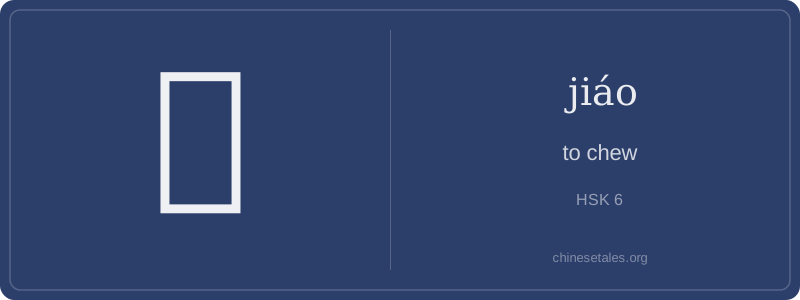
The earliest form of 嚼 appears in seal script (c. 3rd century BCE), where it combined 口 (kǒu, 'mouth') on the left with 爵 (jué, an ancient wine vessel) on the right — not because drinking was involved, but because 爵’s shape resembled a bird’s beak gripping something tightly. Over centuries, 爵 simplified dramatically: its three legs became 舊 (jiù, 'old'), then further eroded into the modern right-hand component — a dense cluster of strokes mimicking the rhythmic, repetitive motion of chewing. The 20 strokes aren’t random: they visually echo the back-and-forth grind — look closely at the tangled hooks and dots in the right half, and you’ll see teeth clashing, saliva flying, jaw muscles tensing.
This character first appeared in the Shuōwén Jiězì (121 CE), defined as 'the action of grinding food with teeth until it softens.' By the Tang dynasty, poets like Bai Juyi used it sensorially — describing monks 'chewing silence' (嚼寂) to convey meditative stillness. Its visual density mirrors its semantic weight: unlike simple verbs like 吞 (tūn, 'to swallow'), 嚼 insists on duration, texture, and embodied effort — making it one of Chinese’s most mouth-filling characters, both literally and linguistically.
Think of 嚼 (jiáo) as Chinese’s answer to the English verb 'chew' — but with far more expressive teeth. While English uses 'chew' mostly literally (chew gum, chew food), in Chinese, 嚼 carries visceral, almost tactile weight: it evokes the grinding resistance of tough meat, the slow, deliberate mastication of a philosopher pondering a paradox, or even the mental 'chewing over' of gossip. It’s never passive — every use implies effort, texture, and time.
Grammatically, 嚼 is refreshingly straightforward: a transitive verb requiring an object (e.g., 嚼东西 — 'chew something'), and it resists reduplication (you don’t say *嚼嚼). Unlike many verbs, it rarely appears in formal writing — you’ll find it in dialogue, essays about sensory experience, or vivid narration. Learners often mistakenly substitute 吃 (chī, 'to eat') or 咬 (yǎo, 'to bite'), but 嚼 specifically means *grinding with molars*, not swallowing or puncturing — a nuance as critical as distinguishing 'sip' from 'gulp'.
Culturally, 嚼 appears in idioms like 嚼舌根 (jiáo shé gēn, 'chew tongue-root') — a brilliantly grotesque metaphor for backbiting gossip, where the tongue itself becomes the thing being ground. A common error? Using jiáo in polite restaurant settings; native speakers prefer 细嚼慢咽 (xì jiáo màn yàn, 'chew thoroughly, swallow slowly') for advice — but never say '请嚼' ('please chew')! That would sound comically rude, like commanding someone to gnaw on their rice.