堡
Character Story & Explanation
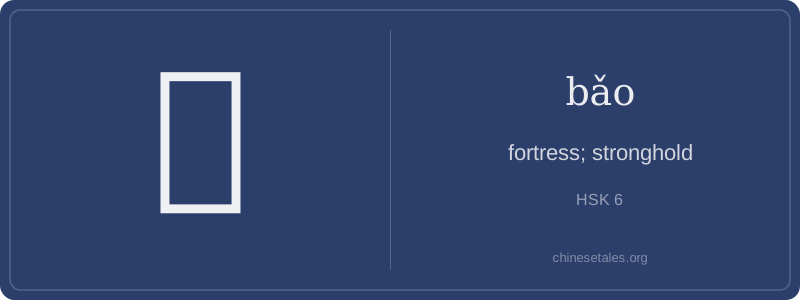
The earliest form of 堡 appears in Han-dynasty clerical script, not oracle bone — because fortresses as permanent earthen-masonry structures became widespread only after the Warring States period. Visually, it’s a clear fusion: the lower 土 radical (three horizontal strokes + a downward stroke) grounds the character in earthwork construction, while the upper 保 was borrowed for both sound and sense. In bronze inscriptions, 保 depicted a person holding a child — symbolizing protection — and that nurturing vigilance transformed into defensive vigilance here. Over centuries, the 保 component simplified from a full figure-and-child to today’s streamlined form, but the ‘guarding earth’ logic remained intact.
By the Tang and Song dynasties, 堡 referred specifically to small, locally administered defensive posts — smaller than cities, larger than outposts — often built by clans or militias in frontier regions. The History of the Yuan Dynasty documents ‘tǔ bǎo’ (earth fortresses) in Gansu, built from rammed earth and watchtowers. Interestingly, the character’s shape mirrors its function: the sturdy 土 base supports the vigilant 保 above — like walls rising from packed earth, manned by watchful guards. This visual hierarchy — foundation first, sentry second — is baked into every stroke.
堡 is a character that feels solid, grounded, and unyielding — like the earth itself holding up stone walls. Its core meaning is 'fortress' or 'stronghold', but it’s never abstract: it always implies human-built defense, strategic location, and layered protection. Visually, it’s anchored by the 土 (earth/soil) radical at the bottom — a reminder that every fortress begins with terrain, foundations, and control of land. The top part, 保 (bǎo), isn’t just phonetic; it carries semantic weight too — 'to protect', 'to safeguard'. So 堡 is literally 'earth-protection': earth fortified by intention.
Grammatically, 堡 appears almost exclusively in nouns — rarely as a verb or adjective. You’ll find it in place names (Wǔlǐbǎo), historical terms (biānsài bǎo), or compound words like 城堡 (chéngbǎo, 'castle'). Learners often mistakenly use it where 塞 (sài, 'frontier pass') or 城 (chéng, 'walled city') would be more precise — e.g., saying *长城堡* instead of 长城 (Great Wall). Also, don’t confuse it with the homophone bǔ (as in 集堡, now archaic); modern standard usage is overwhelmingly bǎo.
Culturally, 堡 evokes Ming-dynasty watchtowers along the Great Wall and northern garrisons built into hillsides — places where geography and military craft fused. It’s not glamorous like 宫 (palace) or vast like 都 (capital); it’s pragmatic, regional, and resilient. A common mistake? Forgetting that 堡 is almost always part of a compound — you’d never say *他住在堡*; it’s *他住在城堡里* or *这座堡已废弃*. Its power lies in specificity, not solitude.