堂
Character Story & Explanation
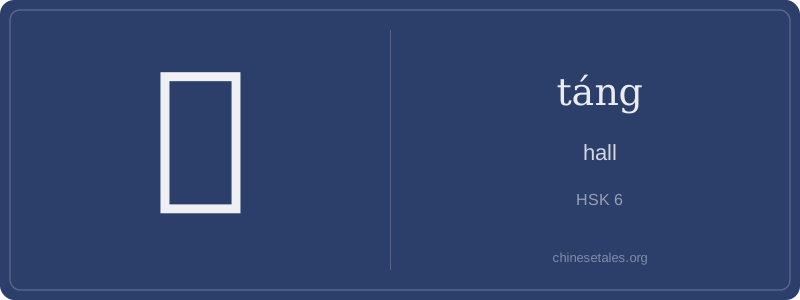
The earliest form of 堂 appears in bronze inscriptions (c. 1000 BCE) as a pictograph showing a roof (冖) over an open structure with pillars — often stylized as two vertical lines — resting on a base representing earth or foundation. The top part evolved into 尚 (shàng, 'still, yet; noble'), suggesting 'what is held aloft with reverence', while the bottom 土 (tǔ, 'earth/soil') root anchors it physically and symbolically — a hall built *on the land*, belonging to the family or community. Over centuries, the seal script simplified the roof and pillar elements into today’s upper 尚, and the earth radical remained firmly at the bottom, preserving the idea of grounded solemnity.
By the Warring States period, 堂 had crystallized as the main reception or ceremonial chamber of a residence — distinct from 卧室 (bedroom) or 厨 (kitchen). Mencius famously said, 'If the ruler does not act like a ruler, the minister should not serve in the hall' (君不君,臣不臣,… 不在堂 — implied in classical allusions), linking the physical space to ethical order. Later, Tang and Song literati used 堂 in studio names (e.g., 东坡堂 Dōngpō Táng) to signal scholarly identity — turning personal space into moral territory. The character’s visual balance — elevated 尚 above solid 土 — mirrors its cultural function: lofty ideals made tangible through rooted tradition.
At its heart, 堂 isn’t just a neutral architectural term like 'hall' — it’s a vessel for hierarchy, dignity, and social gravity. In Chinese, a 堂 isn’t merely a room; it’s where authority resides: the ancestral hall (祠堂 cítáng), the magistrate’s court (公堂 gōngtáng), or the teacher’s lecture space (讲堂 jiǎngtáng). You wouldn’t say *wǒ zài yí ge táng lǐ* ('I’m in a hall') without context — that sounds oddly vague, almost ceremonial. Instead, 堂 almost always appears embedded in compound nouns, rarely standalone.
Grammatically, 堂 functions exclusively as a noun suffix or component in fixed terms — never as a verb, adjective, or measure word. Learners sometimes misapply it like English ‘-hall’ (e.g., *library hall* → *túshūguǎn táng*), but that’s unnatural; native speakers say 图书馆 (túshūguǎn) alone. Also, while many nouns ending in -táng imply formality or tradition, some have flipped meanings: 堂兄 (tángxiōng) means 'father’s brother’s son' — not 'hall-brother'! That ‘táng’ here marks lineage, not architecture — a classic case of semantic borrowing from clan halls where kinship was ritually affirmed.
Culturally, 堂 evokes Confucian spatial ethics: the central hall is where ritual, judgment, teaching, and ancestor veneration converge — literally and symbolically the 'center of moral gravity'. Mistake it for a generic space, and you miss the weight behind every usage. Even modern slang like 堂堂 (tángtáng, 'imposingly dignified') retains that aura — describing someone who stands with unshakeable integrity, as if occupying their own ancestral hall.