经
Character Story & Explanation
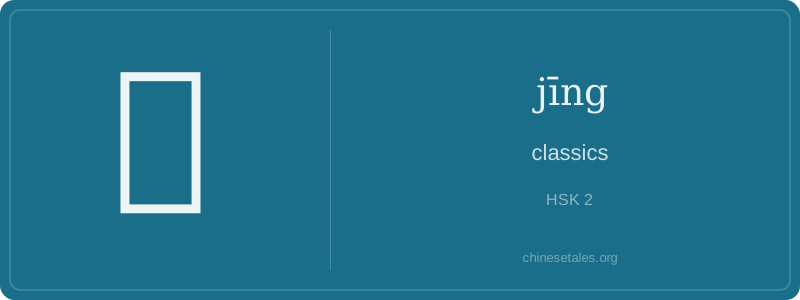
The earliest form of 经 appears in bronze inscriptions as a stylized depiction of loom threads — vertical warp threads held taut on a frame, with the left side showing three parallel strokes (later simplified to 纟, the silk radical) and the right side a phonetic component ‘巠’ (jīng), which itself originally resembled intersecting lines of weft and warp. Over centuries, the three-thread radical condensed into today’s two-stroke 纟, while ‘巠’ streamlined from a complex cross-hatch into the clean, angular shape we see now — still evoking orderly, interwoven structure.
This textile origin shaped its meaning profoundly: in the Shuō Wén Jiě Zì (121 CE), Xu Shen defined 经 as ‘the warp threads — the constant, unchanging foundation upon which the weft (纬, wěi) is woven.’ Just as warp threads hold the fabric’s integrity, classics hold moral and intellectual integrity. By the Han dynasty, the term was applied to Confucian texts canonized as the ‘Five Classics’ — texts so central they were literally treated as the structural threads of civilization.
Imagine you’re in a quiet Beijing courtyard, holding a thin, fragile scroll tied with red silk — not just any scroll, but the Classic of Filial Piety. Your teacher says, ‘This is a jīng — not just an old book, but a living compass for how to live.’ That’s the heart of 经: it’s not merely ‘a classic’ as in ‘old literature,’ but a foundational, authoritative text — one that’s been woven into Chinese thought like warp threads in fabric. It carries weight, reverence, and continuity.
Grammatically, 经 appears in compound nouns (like jīngdiǎn 经典) and as part of verbs meaning ‘to experience’ (jīnglì 经历), thanks to its ancient root meaning ‘to pass through’ or ‘to traverse.’ Yes — same character! Learners often miss this duality: when you say ‘我经历过这件事’ (wǒ jīnglì guò zhè jiàn shì), you’re literally saying ‘I have *passed through* this event’ — echoing the original textile metaphor. Don’t try to use 经 alone as a verb; it only works in compounds.
Culturally, calling something a ‘jīng’ elevates it instantly — the Yì Jīng (I Ching), the Shū Jīng (Book of Documents), even modern terms like wúxiàn jīng (wireless network, lit. ‘wireless *classic/standard*’) borrow its aura of reliability. A common mistake? Confusing it with 惊 (jīng, ‘to frighten’) — same pinyin, wildly different meaning. Remember: 经 has silk (纟), not heart (忄). Silk = tradition, texture, endurance.