进
Character Story & Explanation
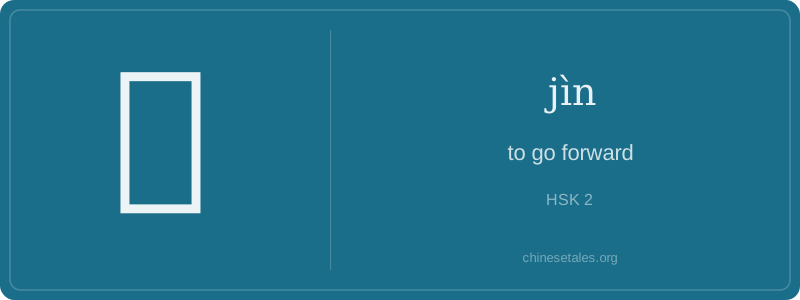
The earliest form of 进 appears in bronze inscriptions as ⿱隹辶 — a bird (隹) above the 'walking' radical (辶), symbolizing swift, directed motion forward, like a bird flying ahead on a path. Over centuries, the top evolved: 隹 simplified into 井 (a stylized cage-like shape representing 'controlled entry'), then further condensed into the modern 井-like top of 进. The bottom remained 辶 — the 'walking' radical, always signaling movement — now with three distinct strokes: the dot (丶), the horizontal fold (㇏), and the sweeping tail (辶). Every stroke traces a footstep crossing a threshold.
This visual logic anchored its meaning: entering a space, advancing in rank, or progressing in skill. In the Analects, Confucius praises students who 'advance without looking back' (进而不顾), linking movement to moral courage. Even today, the character’s shape mirrors its function — the top (the 'entry point') sits above the moving feet (辶), literally showing something *passing through* into a new state. Its elegance lies in how clearly form and function align: no ambiguity, no detour — just forward motion across a clear line.
At its heart, 进 (jìn) is about motion with purpose — not just 'going,' but *advancing*, *entering*, or *progressing* with intention. Think of a door swinging open, a student stepping up to the front of class, or data flowing into a computer. It’s dynamic, directional, and often implies improvement or access: 进学校 (jìn xuéxiào, 'enter school'), 进步 (jìn bù, 'make progress'). Unlike static verbs like 是 (shì, 'to be'), 进 always carries forward momentum.
Grammatically, it’s wonderfully flexible: as a verb ('to enter'), it takes objects directly (进教室 jìn jiàoshì); as part of resultative complements, it pairs with action verbs to show completion or direction — e.g., 吃进 (chī jìn, 'eat into/finish eating up') or 拿进 (ná jìn, 'bring in'). Learners often overuse it where English says 'go' — but 进 isn’t neutral 'go'; it *requires* a boundary crossed: a door, a room, a level, or even an abstract threshold like 'into adulthood.' No boundary? No 进.
Culturally, 进 pulses with Confucian optimism — advancement isn’t just physical; it’s moral and scholarly. The phrase 日进 (rì jìn, 'daily advance') echoes classical ideals of self-cultivation. A common slip? Using 进 instead of 来 (lái) or 去 (qù) for simple movement — saying *我进北京* (wǒ jìn Běijīng) sounds like you’re breaching Beijing’s city walls! Instead, say 我去北京. Remember: 进 means 'cross the line in — and leave your old position behind.'