妥
Character Story & Explanation
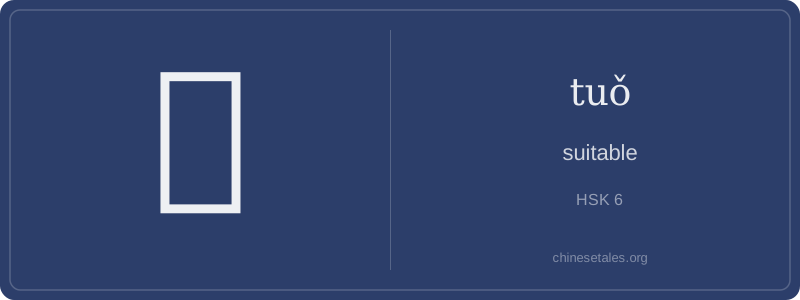
The earliest form of 妥 appears in late Warring States bamboo slips — not as a pictograph of a woman, but as a stylized fusion: the left side is 女 (female), while the right side evolved from 兪 (yú), a phonetic component originally depicting a person with arms raised in submission or agreement. Over centuries, 兪 simplified into the top-heavy ‘shù wān gōu’ (vertical stroke with curved hook) + ‘duǎn héng’ (short horizontal) + ‘diǎn’ (dot) we see today — seven strokes total. Crucially, the radical 女 isn’t about gender here; it signals ‘human relation’, anchoring the character in interpersonal harmony rather than biology.
This visual logic shaped its meaning: in the Zuo Zhuan, 妥 appears in phrases like ‘wèi zhī bù tuǒ’, describing rituals performed *without proper alignment* — not morally wrong, but ritually misfitting. By the Tang dynasty, it shifted from ritual precision to pragmatic suitability, appearing in legal texts to denote agreements ‘properly settled’. The character’s enduring power lies in how its structure mirrors its function: the 女 radical grounds it in human context, while the right side’s flowing, closed shape suggests resolution — like a knot tied tight, not cut.
Imagine you’re negotiating a business deal in Shanghai. Your counterpart pauses, leans forward, and says: 'Zhè ge fāng'àn hái bù tài tuǒ.' That tiny word tuǒ lands like a soft but unshakeable verdict — not ‘wrong’, not ‘bad’, but *not quite right yet*. That’s the essence of 妥: it’s not just ‘suitable’ — it’s the quiet, relational precision of something fitting *just so*, like a lid clicking onto a jar. It carries weight: when something is 妥, it’s been vetted, balanced, and mutually acceptable — no loose ends, no hidden friction.
Grammatically, 妥 rarely stands alone. You’ll almost always see it in compounds (妥当, 妥善, 妥协) or in the pattern bù tài tuǒ / bù tuǒ (‘not quite suitable’) — never *hěn tuǒ* or *fēicháng tuǒ*. It’s a ‘yes-or-no threshold word’: things are either 妥 or not 妥. Learners often mistakenly use it as an adjective like ‘good’ (e.g., *zhè ge xiǎngfǎ hěn tuǒ*), but native speakers would say *zhè ge xiǎngfǎ hěn hǎo* or *zhè ge xiǎngfǎ kě xíng*, reserving 妥 for contexts where harmony, appropriateness, and social alignment are at stake.
Culturally, 妥 embodies Confucian pragmatism — it’s about ‘making things work’ without losing face or disrupting relationships. In official documents, saying a plan is ‘yǐ jīng ānpái tuǒ’ means it’s been coordinated across departments, approved, and logistically sealed. A common mistake? Using 妥 where 好 or 合适 fits better — that subtle shift from ‘socially seamless’ to ‘generally fine’ changes tone entirely. Think of 妥 as the velvet glove on bureaucratic precision.