姆
Character Story & Explanation
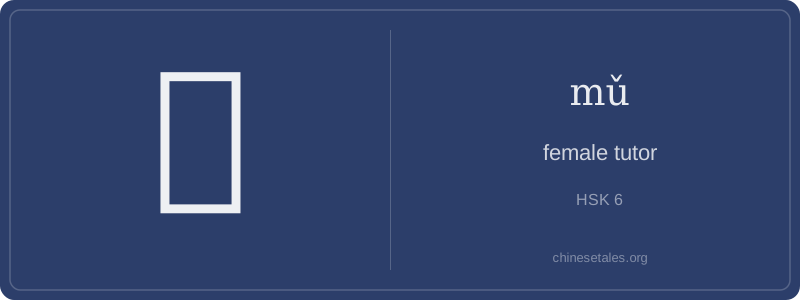
The earliest form of 姆 appears in Warring States bamboo slips — not as a pictograph, but as a phono-semantic compound already. Its left side, 女, was always the 'woman' radical, signaling gendered domain. The right side, 母, wasn’t copied from scratch but borrowed its shape and sound: ancient scribes simplified 母’s original oracle bone form (a woman with exaggerated breasts, ⚭) into three horizontal strokes plus a dot — then reused that streamlined version as the phonetic component for 姆. So visually, 姆 is 女 + 母 — literally 'woman + mother', but functionally 'woman who embodies maternal pedagogy'.
This fusion wasn’t accidental. In the *Book of Rites* (Lǐjì), 'female tutors' (姆) were appointed to instruct noble daughters in rites, speech, and comportment before marriage — roles explicitly modeled on maternal wisdom but elevated to institutional duty. By the Tang dynasty, 姆 had shifted toward household roles: the *Tang Liudian* records 'household tutors' (家姆, jiā mǔ) overseeing maidservants and young mistresses. Even today, its visual echo of 母 reminds us: this isn’t just teaching — it’s embodied, trusted, intergenerational guidance rooted in feminine authority.
At its heart, 姆 (mǔ) is a quiet powerhouse — not just 'female tutor,' but a culturally loaded term for a respected, experienced woman who mentors, guides, and nurtures, often in domestic or intimate settings. It carries warmth, authority, and subtle hierarchy: unlike the neutral teacher 老师 (lǎoshī), 姆 implies personal involvement, moral grounding, and long-standing trust — think of a grandmotherly figure shaping character, not just delivering curriculum.
Grammatically, 姆 almost never stands alone. It’s a bound morpheme: you’ll see it only in compounds like 保姆 (bǎomǔ, 'nanny') or 姐妹花姆 (jiěmèihuā mǔ, 'godmother to sisters'). Crucially, it’s never used as a title before a name (e.g., *姆老师 is wrong); instead, it appears *after* classifiers or relational terms — e.g., 我家的姆 (wǒ jiā de mǔ, 'the female tutor in my family'), or in fixed roles like 教母 (jiàomǔ, 'godmother'). Learners often mistakenly use it like an honorific, but it functions more like a semantic suffix anchoring feminine mentorship.
Culturally, 姆 evokes pre-modern Confucian pedagogy where women educated girls in ritual, embroidery, and virtue within the inner chambers — hence its radical 女 (nǚ, 'woman') and phonetic component 母 (mǔ, 'mother'), which also signals nurturing authority. A common error? Confusing it with 母 (mǔ, 'mother') — but while 母 is broad and biological, 姆 is strictly social, professional, and gendered expertise. Also, don’t expect it in formal education contexts; this is the realm of home, lineage, and spiritual kinship.