婪
Character Story & Explanation
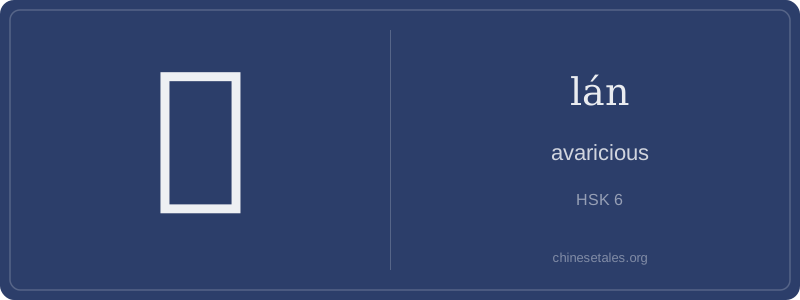
The earliest form of 婪 appears in Warring States bamboo slips: a 'woman' radical (女) on the left, and on the right, a stylized depiction of a tiger’s head (林 + 火-like strokes), symbolizing ferocious, devouring hunger. Over centuries, the tiger-head morphed into 林 (lín, 'forest') — evoking dense, tangled, uncontrollable growth — and below it, 火 (huǒ, 'fire') softened into 灬 (four dots), representing burning, consuming heat. By the Han dynasty, the structure solidified as 女 + 林 + 灬 — 11 strokes total — visually screaming 'a woman consumed by forest-fire desire'.
This visual metaphor crystallized its meaning: not simple want, but *ravenous, self-consuming craving*. In the Han Feizi, 婪 appears in warnings about ministers whose '婪心' (lán xīn, 'avaricious hearts') corrode statecraft. Later, in Tang poetry, it described imperial hoarding — '婪敛' (lán liǎn, 'rapacious exaction'). The 'woman' radical isn’t sexist; it reflects ancient cosmology linking yin (female principle) with receptivity — and thus, dangerous openness to excess. The character’s power lies in how its very strokes burn with the heat they describe.
Imagine a Ming dynasty merchant hunched over ledgers in a dimly lit shop, fingers stained with ink and greed — not just wanting more, but *devouring* wealth like a ravenous beast. That’s 婪 (lán): not mere 'greedy' or 'covetous', but an almost visceral, insatiable avarice — the kind that blurs moral lines and swallows reason whole. It’s literary, weighty, and rarely used in casual speech; you’ll find it in essays, classical allusions, or sharp political commentary — never in 'I want dessert'.
Grammatically, 婪 is almost always bound: it appears in compounds like 贪婪 (tān lán) or as the second character in fixed four-character idioms (e.g., 婪得无厌). You won’t say '他很婪' — that’s ungrammatical. Instead, it pairs with verbs (如:婪欲、婪求) or functions adjectivally only within compound nouns. Its tone (second tone) and low-frequency usage mean learners often misplace it — confusing it with 贪 (tān), which *can* stand alone.
Culturally, 婪 carries Confucian disdain for unchecked desire — it’s the greed that breaks harmony, not just personal ambition. A common mistake? Using it where 贪 suffices — overloading a sentence with literary gravity when plainness is expected. Also, watch the radical: though it has 女 (nǚ, 'woman'), it’s *not* gendered in meaning — a historical artifact, not a stereotype. Ancient scribes placed 'woman' here not to blame women, but because early forms linked desire to bodily appetite — a nuance lost in translation but vital for deep understanding.