媳
Character Story & Explanation
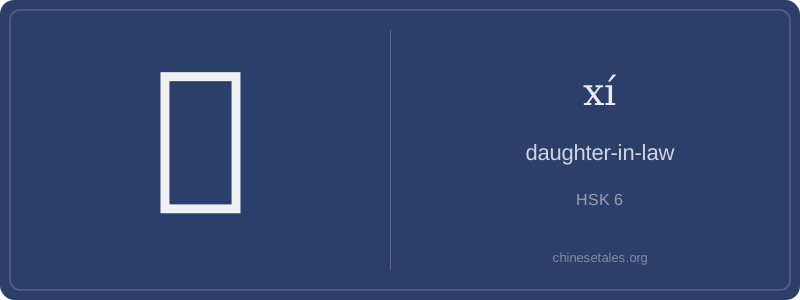
The earliest form of 媳 appears in seal script (c. 3rd century BCE), where it combined the ‘woman’ radical 女 on the left with 台 (tái) on the right—a phonetic component that also carried connotations of ‘platform’ or ‘elevated position’. The 台 element itself evolved from an ancient pictograph of a ceremonial stand, suggesting status and ritual placement. Over time, the right side simplified from 台 to 夷 (yí)—a variant shape that preserved the sound but subtly shifted visual weight toward ‘calm submission’ (as 夷 also means ‘to pacify’). By the Song dynasty, the modern form stabilized: 女 + 夷, thirteen strokes total—each stroke reinforcing the idea of a woman entering a new social platform.
This evolution mirrors its semantic journey: from early texts like the Rites of Zhou, where 媳 described a bride formally ‘installed’ in her husband’s ancestral hall, to Tang poetry where it appeared in laments about young brides weeping at departure. Confucian classics emphasized the 媳’s duty to ‘serve three generations’—her husband, his parents, and his grandparents. Interestingly, the character’s visual pairing of 女 (female) and 夷 (to pacify/subdue) quietly reflects the historical expectation that the daughter-in-law harmonize the household—even at personal cost. No wonder classical writers called her ‘the hinge of the family door’.
At its heart, 媳 (xí) isn’t just a neutral kinship term—it’s a cultural pressure point. In traditional Chinese family structure, the daughter-in-law occupies a uniquely delicate position: she enters her husband’s lineage, often leaving her natal home behind, and must navigate complex hierarchies—respecting elders, managing household duties, and proving herself to her in-laws. That weight is baked into the word: you’ll rarely hear it used affectionately without modifiers like ‘贤’ (xián, virtuous) or ‘孝顺的’ (xiàoshùn de, filial). It carries quiet expectation, not just relationship.
Grammatically, 媳 is almost never used alone—it appears in compounds (儿媳, 媳妇) or with possessives (他的媳妇, 我家的媳妇). Crucially, it’s *not* interchangeable with ‘wife’: 媳 specifically denotes the wife *from the perspective of the husband’s family*. So while ‘他妻子’ (tā qīzi) means ‘his wife’, ‘他媳妇’ (tā xífu) means ‘his daughter-in-law’—but only when spoken *by his parent*! This perspective-dependence trips up even advanced learners.
Culturally, modern usage has softened slightly—especially in urban settings—but the term still evokes generational duty. A common mistake? Using 媳 where 妻 (qī) or 老婆 (lǎopó) would be more natural for ‘my wife’. Also, note that 媳 is almost always written as part of 媳妇 (xífù), not standalone—except in formal or literary contexts (e.g., ‘新媳入门’). Its rarity as a solo character signals how deeply relational—and context-bound—this role remains.