嫂
Character Story & Explanation
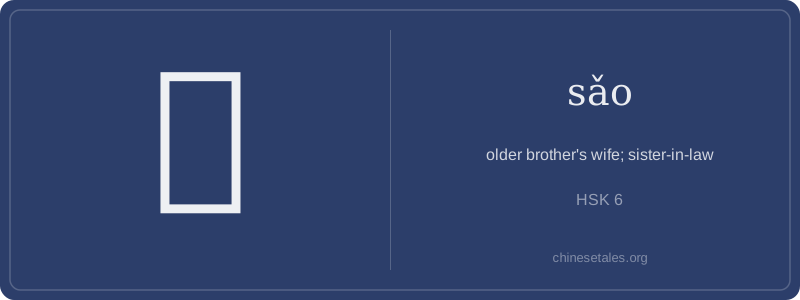
The earliest form of 嫂 appears in bronze inscriptions from the Western Zhou (c. 1046–771 BCE), where it combined the 'woman' radical (女) with 叚 (jiǎ), an ancient variant of 早 (zǎo, 'early') — not as a phonetic borrowing, but as a visual metaphor: a woman positioned *before* (i.e., senior to) others in the marital hierarchy. Over centuries, 叚 simplified and merged with 皂 (zào, 'black dye'), which itself evolved from a pictograph of a hand holding a cleaning tool — hinting at the domestic responsibilities expected of the eldest brother’s wife. By the Han dynasty, the modern structure stabilized: 女 on the left, 皂 on the right, its 12 strokes carefully balancing feminine grace and structural firmness.
This evolution mirrors its semantic journey: from a functional descriptor ('the woman who came first in the brother’s marriage') to a full-fledged relational title loaded with moral expectation. In the classic Rites of Zhou, the 嫂 is cited as the model for 'harmonious household management' — her conduct sets the tone for younger sisters-in-law and children alike. Even today, the character’s right side 皂 subtly echoes this legacy: historically, black-dye workshops were run by senior women managing apprentices — a quiet visual echo of authority, order, and stewardship embedded in every stroke.
Think of 嫂 (sǎo) as Chinese kinship’s version of a 'title + relationship' hybrid — like calling someone 'Dr. Smith' in English, but where the title *is* the relationship. It’s not just 'older brother’s wife'; it’s a term of respectful address that carries weight, warmth, and subtle hierarchy — you’d never call her 'my brother’s wife' in casual speech; you say 嫂 or 嫂子 (sǎo·zi), and that single syllable signals your place in the family tree. Unlike English, where 'sister-in-law' lumps together multiple relationships, 嫂 is hyper-specific: only for your elder brother’s wife — no exceptions.
Grammatically, it functions both as a noun ('my sǎo') and as an honorific title used directly in address ('Sǎo, come have tea!'). You’ll often see it reduplicated as 嫂子 — the -zi suffix softens formality, adding familiarity without losing respect. Crucially, it’s never used reflexively (you don’t say 'I am sǎo'); it’s always relational and other-directed. Learners sometimes mistakenly use it for younger brothers’ wives (that’s 弟妹, dìmèi) or overgeneralize to any female in-law — a social faux pas that can make you sound either clueless or overly familiar.
Culturally, 嫂 embodies Confucian role clarity: she steps into a quasi-maternal, household-coordinating role in many traditional families. In rural areas or older generations, calling someone 嫂 may even imply tacit acceptance into the family — it’s warmer than 阿姨 (āyí) but more formal than 姐姐 (jiějie). Interestingly, in northern dialects, 嫂子 is sometimes playfully extended to admired older women outside kinship (e.g., a kind shop owner), but this is contextual and affectionate — never presumptuous.