嫉
Character Story & Explanation
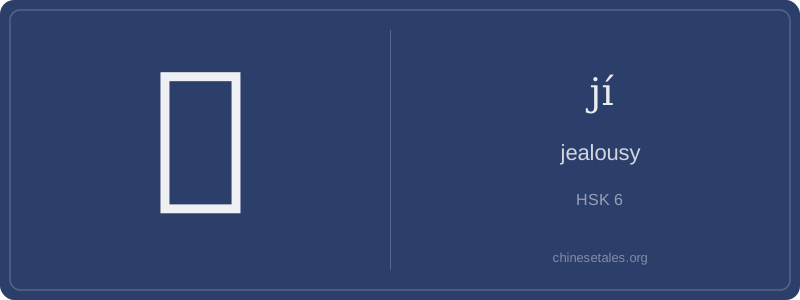
The earliest form of 嫉 appears in Warring States bamboo slips — not as a pictograph, but as a phonosemantic compound already. Its left side, 女 (nǚ, ‘woman’), signals association with human emotion (many abstract feelings — like 怒 ‘anger’, 好 ‘like’, 妒 ‘envy’ — carry this radical), while the right side, 疾 (jí, ‘illness, rapid’), provides both sound and meaning. 疾 itself evolved from oracle bone script depicting an arrow piercing a person — symbolizing sudden, penetrating affliction. So 嫉 was conceived as ‘a woman afflicted by sudden, piercing resentment’ — a visceral metaphor, not a gendered stereotype.
This visual logic deepened over time. By the Han dynasty, 嫉 appeared in Sima Qian’s Records of the Grand Historian, describing ministers who ‘嫉贤而蔽善’ (jí xián ér bì shàn) — ‘jealously blocked the worthy and concealed virtue’. The character’s structure reinforced its meaning: the ‘woman’ radical grounded it in human relational emotion, while ‘illness’ (疾) insisted this wasn’t mere dislike — it was a contagious, destabilizing condition. Even today, the stroke count (13) echoes its tension: 3 strokes for 女, 10 for 疾 — a near-perfect imbalance mirroring the distortion jealousy causes in perception.
Imagine a quiet office where Li Wei just got promoted — and across the room, Zhang Mei’s smile doesn’t quite reach her eyes. Her shoulders tense; she scrolls past his celebration post without liking it, then mutters, '他有什么了不起?' That flicker of resentment, that sour twist in the gut when someone else shines *just a little too brightly* — that’s 嫉 (jí). It’s not casual envy; it’s sharp, inward, often unspoken, and carries moral weight: classical texts like the Book of Rites warn that unchecked 嫉 undermines harmony. Unlike English ‘jealousy’, which can blur with romantic insecurity, 嫉 is almost always about *social comparison*: talent, status, luck — never love.
Grammatically, 嫉 is almost never used alone. You’ll see it bound tightly in compounds: 嫉妒 (jí dù) is the full noun/verb pair (‘to feel jealousy’), while 嫉贤妒能 (jí xián dù néng) — literally ‘jealous of the worthy, envious of the capable’ — is a four-character idiom condemning petty obstruction of talent. Learners mistakenly try to say ‘我嫉他’ — but no: 嫉 *requires* a compound or context. It’s a linguistic warning label: this emotion is too potent for solo use.
Culturally, 嫉 sits uncomfortably between Confucian ideals of humility and human reality. Calling someone 嫉贤妒能 isn’t just descriptive — it’s a serious moral indictment, implying they’re sabotaging collective progress. A common mistake? Overusing 嫉 as a direct translation of English ‘jealous’. In Chinese, saying ‘I’m jealous of your new phone’ sounds oddly harsh — better use 羡慕 (xiàn mù) for benign envy. 嫉 implies something darker: a threat to fairness, even virtue.