孔
Character Story & Explanation
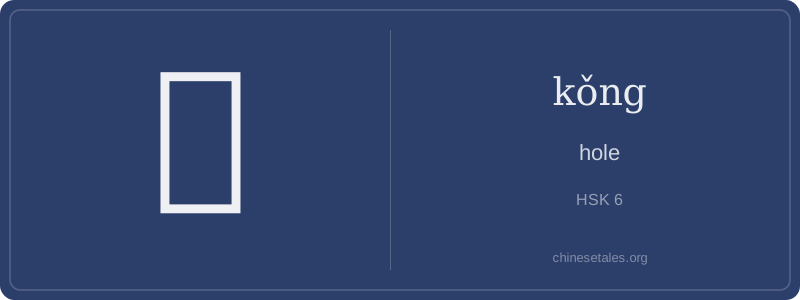
The earliest form of 孔, found on Shāng dynasty oracle bones, was a vivid pictograph: a stylized 'child' (子) with a prominent circular opening drawn beside or through it — sometimes even as a dot inside the child’s torso! This wasn’t literal anatomy; it represented a *vital aperture* — like the mouth of a bell or the eye of a needle. Over centuries, the 'child' (子) became the radical at the left, while the right side simplified from a full circle (口 or ⚪) into two short strokes: the top dot (丶) and the curved stroke (乚) — capturing the essence of a small, defined opening with minimal ink.
This evolution reflects how meaning deepened: from physical cavity → resonant channel → symbolic gateway. In the *Analects*, Confucius is repeatedly called 孔子 — a title that embeds the character not as 'hole' but as *the one who opens understanding*. The visual link persists: just as a bell’s 孔 amplifies sound, Confucius’s words amplify virtue. Even in Tang poetry, 孔 is used for 'eye of the needle' (针孔) or 'pupil of the eye' (瞳孔), always implying precision, focus, and connection — never mere emptiness.
At first glance, 孔 (kǒng) means 'hole' — but in Chinese thinking, it’s never just empty space. It’s a portal: for light, air, sound, or meaning. That’s why 孔 appears in 孔子 (Kǒngzǐ, Confucius) — not because he was ‘hole-like,’ but because his teachings are the *opening* through which wisdom enters the world. Native speakers feel this duality instinctively: a hole isn’t absence; it’s potential, passage, resonance.
Grammatically, 孔 is mostly a noun (e.g., 针孔 zhēn kǒng — 'pinhole') or part of compound nouns, rarely used alone in speech. Crucially, it’s *not* used for abstract 'gaps' like time or opportunity — that’s 缺口 (quēkǒu) or 空档 (kòngdàng). Learners often overextend it: saying *时间孔* for 'time gap' sounds bizarre, like calling a pause in music a 'violin hole.' Also, note its tone: kǒng (third tone), not kōng (first tone — which means 'empty'). Mixing them changes everything.
Culturally, 孔 carries quiet reverence — from the ritual bronze bells with resonant 孔 (to amplify sacred sound) to Confucius’s name itself, where the character subtly signals his role as a conduit of virtue. Even today, when engineers say 气孔 (qìkǒng — 'stomata' or 'vent'), they’re invoking an ancient idea: holes that breathe life into systems. Mistake this for a mere 'hole,' and you miss the heartbeat beneath the surface.