孤
Character Story & Explanation
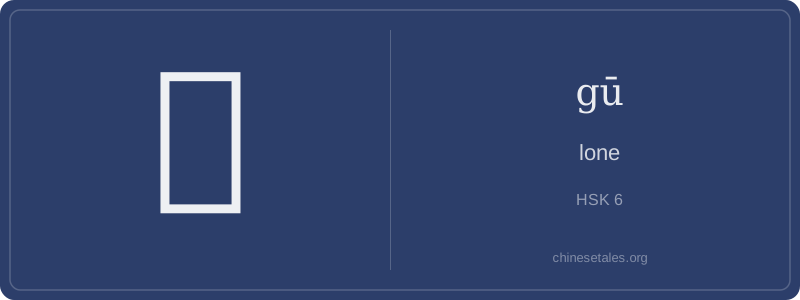
The earliest form of 孤 appears in bronze inscriptions as a combination of 子 (zǐ, 'child') and 古 (gǔ, 'ancient') — not a pictograph of solitude, but a phonetic-semantic compound. The left side 子 clearly depicts a child with arms and legs, while the right 古 originally showed a mouth (口) atop a ten (十), representing 'words spoken long ago.' Over centuries, 古 simplified from its oracle bone complexity into today’s clean, angular form — and the whole character stabilized at eight strokes: two horizontal lines, a dot, a hook, then four strokes forming 古. Visually, it’s balanced — child on the left, antiquity on the right — hinting that this ‘lone’ state is both human and timeless.
This duality shaped its meaning: in the *Zuo Zhuan*, rulers used 孤 self-referentially to express sovereign humility — ‘this lone one who bears the Mandate.’ By the Han dynasty, it extended to orphans (孤儿), emphasizing loss of paternal protection. The character’s structure reinforces this: 子 (vulnerable child) + 古 (unyielding tradition) = a lone figure defined not by absence, but by enduring role. Even today, when a CEO says 我孤掌难鸣 (‘One hand can’t make a sound’), they’re invoking millennia of layered resonance — not just ‘I’m alone,’ but ‘I stand where no other may stand.’
Think of 孤 (gū) as the Chinese equivalent of the lone cowboy in a Spaghetti Western — not just 'alone,' but carrying quiet dignity, historical weight, and a hint of melancholy nobility. It conveys isolation by circumstance (or choice), not mere physical solitude: a widowed ruler, an orphaned prince, or a scholar exiled to the frontier. Unlike the neutral 独 (dú, 'alone' as in 'solo'), 孤 implies vulnerability *and* moral authority — it’s the loneliness that commands respect.
Grammatically, 孤 is mostly an adjective or noun, rarely a verb. You’ll see it in formal or literary contexts: 孤儿 (gū ér, 'orphan') or 孤身 (gū shēn, 'alone, unaccompanied'). Crucially, it almost never stands alone as a predicate — you wouldn’t say *‘他孤’* ('He is lone'); instead, you’d say *‘他孤身一人’* ('He is all alone') or *‘他形影相吊’* (a classical idiom). Learners often mistakenly use it like English ‘lonely’ — but 孤 isn’t emotional; it’s structural, social, and often honorific.
Culturally, 孤 carries Confucian gravity: ancient kings called themselves 孤 (‘this lonely one’) as a humble-yet-sovereign title — signaling their unique, irreplaceable position, not insecurity. Today, misusing 孤 in casual speech (e.g., texting *‘今天好孤’*) sounds oddly archaic or even comically tragic. It’s a word that breathes with history — best reserved for literature, official documents, or solemn reflection.