宅
Character Story & Explanation
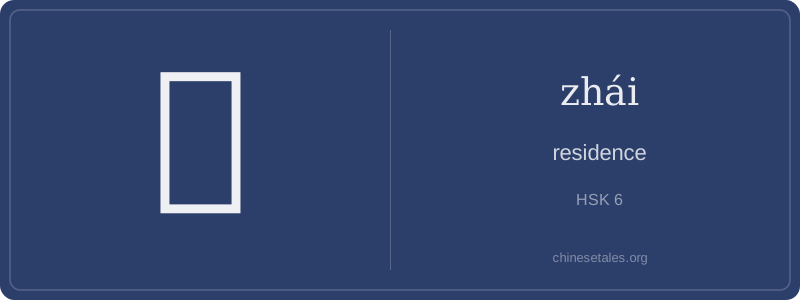
The earliest form of 宅 appears in Western Zhou bronze inscriptions as a pictograph showing a roof (宀) over a cross-shaped symbol representing a settled, ordered space — possibly an altar or central hearth. The original six strokes weren’t arbitrary: the top 宀 (roof) frames the interior, while the lower part (乇) evolved from a glyph meaning ‘to settle’ or ‘to stabilize,’ suggesting a place where people pause, gather, and belong. Over centuries, the lower component simplified from a complex ritual sign into the clean, angular 乇 we see today — but the idea remained: not just shelter, but intentional, dignified habitation.
By the Han dynasty, 宅 was already entrenched in legal and philosophical texts — the Book of Rites describes ‘the proper arrangement of the ancestral 宅’ as essential to filial piety. Its visual simplicity (just six strokes!) belies its weight: the roof 宀 literally shelters the concept of ‘settled presence.’ Interestingly, in Tang poetry, 宅 often appears alongside words like 深 (shēn, deep) or 静 (jìng, quiet), reinforcing its association with seclusion, refinement, and inner cultivation — a far cry from its modern internet twist as ‘homebody.’
At its core, 宅 (zhái) isn’t just ‘residence’ — it’s a quiet anchor of stability, dignity, and social standing. In classical Chinese, it meant ‘a dwelling worthy of a noble person,’ carrying connotations of order, propriety, and rootedness — think less ‘apartment’ and more ‘ancestral hall.’ Even today, when you say 住宅 (zhùzhái), you’re not just naming a building; you’re implying legitimacy, permanence, and belonging to a place that reflects who you are.
Grammatically, 宅 is almost never used alone in modern speech — it’s a classic ‘bound morpheme’: you’ll see it only in compounds like 别墅 (biéshù, villa) or 宅基地 (zháijīdì, rural residential land). Learners often mistakenly try to say *‘wǒ zhái’* for ‘my home,’ but that’s ungrammatical — instead, use 我家 (wǒ jiā) or 我的住所 (wǒ de zhùsuǒ). It also appears in the internet-born noun 宅男/宅女 (zhái nán/zhái nǚ), where it sheds its classical gravitas entirely and becomes playful slang — literally ‘home-person,’ i.e., someone who prefers staying in.
Culturally, 宅 reveals how deeply Chinese thought links physical space with moral and social identity: your residence is where virtue is cultivated (as Confucius said, ‘a gentleman settles his virtue in his dwelling’). A common mistake? Over-translating it as ‘house’ — but 宅 rarely refers to structure alone; it evokes function, status, and continuity. And yes — it’s HSK 6 because while simple-looking, its usage is highly contextual, formal, and almost always compound-bound.