宇
Character Story & Explanation
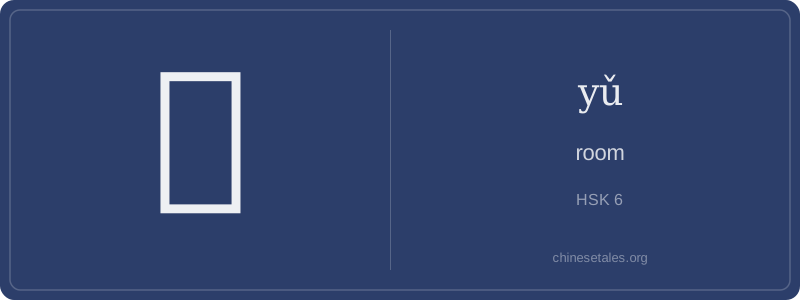
The earliest form of 宇 appears in bronze inscriptions as a stylized roof (宀) with a person-like figure (于, originally depicting a plow or ritual tool) beneath it — not a person, but a symbol of occupation and containment. The roof radical 宀 was unmistakable: three strokes forming a peaked shelter. Below it, the component 于 evolved from a pictograph of a farming implement planted in soil, suggesting 'a defined space where activity occurs.' Over centuries, 于 simplified into its modern boxy shape, while 宀 retained its protective curve — six strokes total, each reinforcing the idea of enclosure: two dots (roof supports), a horizontal line (ridgepole), and three downward strokes (rafters and walls).
This visual logic shaped its meaning trajectory: in the Shījīng (Book of Songs), 宇 described the eaves where one stood to watch rain — a liminal, protected threshold between inside and outside. By the Warring States period, philosophers like Zhuāngzǐ extended it to 'the space within which all things exist,' paving the way for 宇宙. Even today, when Chinese scientists name spacecraft 'Tiangong' (Heavenly Palace), they’re invoking 宇’s ancient resonance — not just 'space' as vacuum, but space as cultivated, inhabited, meaningful shelter.
At first glance, 宇 (yǔ) means 'room' — but that’s just the tip of the iceberg. In classical Chinese, it meant the 'eaves' or 'roof overhang' of a building, evoking shelter, boundary, and vertical space. Over time, it ballooned metaphorically: from physical roof → enclosed space → domain → the entire universe. Today, it rarely stands alone as 'room' (that’s usually 房间); instead, it appears in lofty, literary, or technical compounds like 宇宙 (yǔ zhòu, 'universe') or 宇航 (yǔ háng, 'spaceflight'). It carries gravitas — you’d say 宇内 (yǔ nèi, 'within the realm') in an essay on imperial unity, not when asking where the bathroom is.
Grammatically, 宇 is almost never used by itself as a noun in modern speech — it’s a bound morpheme. Learners often mistakenly insert it into casual sentences ('This room is big' → *这个宇很大), but that sounds archaic or poetic, like saying 'This chamber doth loom large.' Instead, it thrives in compound nouns and formal registers: 宇称 (yǔ chēng, 'parity' in physics), 宇文 (Yǔwén, a surname), or even brand names like 宇通 (Yǔtōng, a bus company). Its tone (third tone) also trips learners up — it’s easy to mispronounce as yú or yǔ, especially before rising-tone words like 宙 (zhòu).
Culturally, 宇 anchors China’s cosmic worldview: 宇 (space, the 'horizontal' expanse under the roof) pairs with 宙 (time, the 'vertical' flow through generations) to form 宇宙 — a uniquely Chinese conception of spacetime as sheltered, bounded, and human-scaled. A common mistake? Confusing 宇 with 家 (jiā, 'home'), which implies warmth and family, whereas 宇 implies structure, scope, and sometimes cold grandeur — think 'the Emperor’s celestial domain,' not 'my cozy apartment.'