宏
Character Story & Explanation
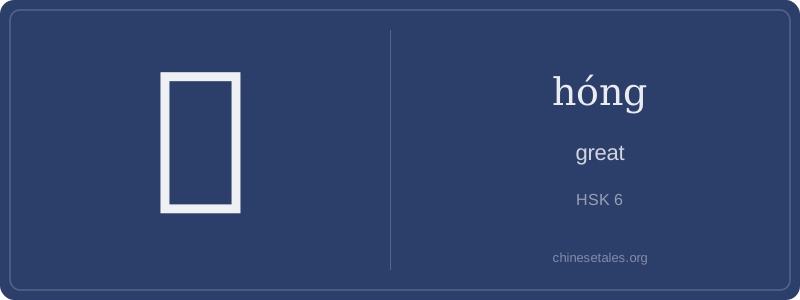
The earliest form of 宏 appears in bronze inscriptions of the Western Zhou dynasty (c. 1046–771 BCE) as a compound: a roof (宀) over a tool or measuring device (工). Unlike pictographs of animals or natural elements, this was an abstract concept from day one — visualizing ‘a roof engineered to span vast space.’ Over centuries, the roof simplified into the modern 宀, while 工 retained its clean, angular strokes. No radical change occurred; instead, stroke count stabilized at seven (宀: 3 strokes + 工: 4 strokes), preserving its balanced, grounded-yet-soaring structure.
This structural duality shaped its semantic journey. In the *Zuo Zhuan*, 宏 described ‘broadly benevolent governance’ — greatness measured not by power, but by reach and inclusivity. By the Tang dynasty, it appeared in poetry praising ‘hóng yīn’ (resonant, far-carrying sound), linking physical amplitude with moral authority. The roof (宀) evokes protection and domain; 工 suggests deliberate construction — so 宏 has always meant greatness *that is intentional, structured, and socially consequential*, not merely impressive.
Imagine you’re standing beneath the vast, soaring roof of the Forbidden City’s Hall of Supreme Harmony — not just any roof, but one that arches high above imperial thrones, echoing with centuries of edicts. That’s the feeling 宏 (hóng) gives in Chinese: not mere ‘big,’ but *expansive grandeur* — majestic, resonant, and deliberately elevated. It’s the adjective you’d use for a vision, a policy, or a legacy — never for a big apple or a loud voice. Think of it as ‘great’ with architectural dignity: 宏伟 (hóng wěi) means ‘magnificent’ (as in a monument), not ‘very large.’
Grammatically, 宏 almost never stands alone. It’s a literary, formal modifier — always paired: 宏图 (grand plan), 宏观 (macro-), 宏愿 (lofty aspiration). You’ll rarely hear it in casual speech; saying ‘hóng de shì’ (a great thing) sounds stiff and unnatural — native speakers would choose 伟大 (wěidà) or 壮大 (zhuàngdà) instead. Learners often overuse 宏 thinking it’s a direct synonym for ‘great,’ missing its built-in aura of scale, intentionality, and solemnity.
Culturally, 宏 carries Confucian weight: it implies greatness that serves harmony and order — like a ruler’s 宏略 (grand strategy) or China’s 宏观经济 (macroeconomy). Its radical 宀 (roof) signals sheltering scope; the right side 工 (gōng) hints at craftsmanship — suggesting greatness isn’t accidental, but *designed*. Misplacing it (e.g., using 宏 instead of 洪 for ‘flood’) breaks meaning entirely — a classic HSK 6 trap where tone and shape both matter.