宗
Character Story & Explanation
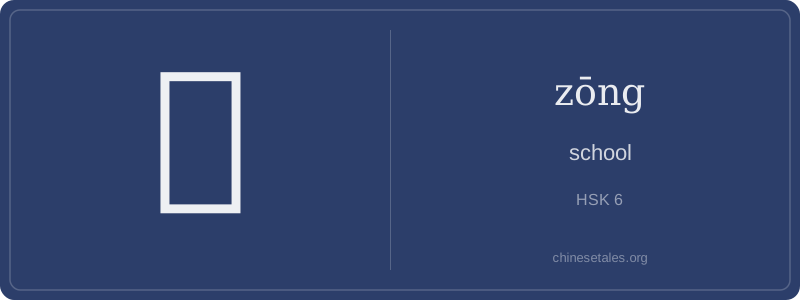
The earliest form of 宗 appears in oracle bone inscriptions as a combination of 宀 (mián, ‘roof’) over 示 (shì, ‘altar’ or ‘spirit tablet’). That original pictograph showed a sacred space under a roof—a family shrine where ancestors were venerated. Over time, the 示 component simplified into the two dots and cross shape we see today (the ‘altar’ part), while 宀 retained its roof-like cover—8 strokes total, each contributing to that sense of sheltered reverence. By the bronze script era, the structure was already stable: roof protecting the sacred core.
This shrine imagery directly shaped its semantic evolution. From literal ancestral altar, 宗 broadened to mean ‘clan’ (as in 宗族 zōngzú), then to ‘founding master’ or ‘orthodox lineage’—because just as ancestors are the spiritual source of a family, a ‘school’ (宗) is the doctrinal source of a tradition. Mencius used 宗 in ‘宗师’ to honor Confucius as the foundational teacher, and later dynastic histories referred to Buddhist sects as 禅宗 (Chánzōng) — not ‘meditation school’ literally, but ‘the lineage founded by Bodhidharma’. The roof still shelters the tradition; the altar still holds its source.
At its heart, 宗 (zōng) isn’t just ‘school’ in the sense of a building—it’s about lineage, orthodoxy, and authoritative tradition. Think of it as ‘the root source’ or ‘the founding line’: whether it’s a philosophical school (like Confucianism), a religious sect (Buddhist or Daoist), or even an ancestral clan—what matters is legitimacy through continuity and reverence for origin. The character feels weighty, formal, and slightly reverent—not casual like 学校 (xuéxiào).
Grammatically, 宗 functions almost exclusively as a noun or as the second element in compound nouns (e.g., 儒宗 rúzōng ‘Confucian master’, 道宗 dàozōng ‘Daoist school’). You’ll never say *‘I study at a 宗’*—it doesn’t work like a standalone institution name. Instead, it appears in titles, academic discourse, and classical or literary contexts: 宗师 (zōngshī) means ‘grandmaster’, not just ‘teacher’ but one who embodies and transmits the entire tradition. Learners often mistakenly use 宗 where they mean ‘subject’ (学科 kēxué) or ‘field of study’ (领域 lǐngyù)—but 宗 always implies authority, inheritance, and ideological cohesion.
Culturally, 宗 carries deep resonance with China’s emphasis on orthodoxy and succession—especially in philosophy, religion, and art. In classical texts like the *Zhuangzi*, ‘宗’ appears in phrases like ‘万宗归一’ (wàn zōng guī yī, ‘ten thousand schools return to one’), highlighting how diverse traditions ultimately trace back to a shared source. A common error? Overgeneralizing it to modern education: saying ‘我的专业是文学宗’ sounds archaic and wrong—use 文学专业 (wénxué zhuānyè) instead. Remember: 宗 isn’t about curriculum; it’s about canon.