寝
Character Story & Explanation
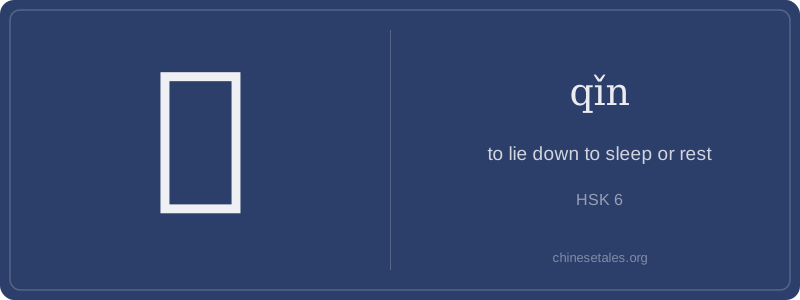
The earliest oracle bone script for 寝 showed a person lying face-down under a roof — a clear pictograph of ‘reclining beneath shelter’. By the bronze script era, the figure simplified into a stylized ‘person + bed’ shape beneath 宀, and later, during the seal script period, the lower component evolved into 侵 — not because of invasion, but because its pronunciation (qīn) matched the word for ‘lie down’, making it a perfect phonetic loan. The modern form retains that elegant balance: the roof 宀 (3 strokes) crowns the character, while the 10-stroke 侵 below provides both sound and visual heft — 3 + 10 = 13 strokes, mirroring the idea of settling fully into rest.
This character appears early in classical texts: in the *Zuo Zhuan*, 寝 describes rulers retiring for state-sanctioned rest; in the *Analects*, Confucius uses 寝 to contrast proper conduct — ‘He did not recline improperly’ (寢不尸) — implying posture and intention mattered as much as sleep itself. Even today, the visual echo remains: those horizontal lines in 侵 resemble mattress stripes, and the whole character looks like a person calmly sinking beneath a protective roof — not collapsing, but *assuming position*.
At its heart, 寝 (qǐn) isn’t just ‘to sleep’ — it’s the quiet, deliberate act of *lying down to rest*, often with dignity, formality, or even solemnity. Think less ‘crashing on the couch’ and more ‘retiring to one’s chamber’ — it carries weight, ritual, and sometimes gravity (like lying in state). Its 宀 (mián) radical — the ‘roof’ — immediately grounds it in a private, sheltered interior space, while the bottom half, 侵 (qīn), originally meant ‘to invade’ but here functions phonetically *and* subtly suggests the body ‘entering’ or ‘settling into’ the bedspace.
Grammatically, 寝 is mostly literary or formal: you’ll rarely hear it in casual speech (people say 睡觉 instead), but it shines in compound verbs like 废寝忘食 (wèi qǐn wàng shí — ‘neglect sleep and forget meals’, i.e., work obsessively) or passive constructions like 不得不寝 (bù dé bù qǐn — ‘has no choice but to lie down/rest’). It’s also common in classical idioms and bureaucratic or medical contexts — e.g., 寝室 (qǐn shì, ‘dormitory’) implies an official, assigned sleeping space, not just any bedroom.
Culturally, 寝 evokes Confucian restraint: resting isn’t indulgence — it’s a regulated, respectful pause. Learners often misapply it as a direct synonym for ‘sleep’ (睡), leading to unnatural phrasing like *‘我寝了’ — which sounds archaic or even funereal. Also, watch tone: qǐn (third tone) is easily mispronounced as qīn (first tone), confusing it with 亲 (‘intimate’) or 侵 (‘invade’). Remember: 寝 is *ritual repose*, not routine slumber.