审
Character Story & Explanation
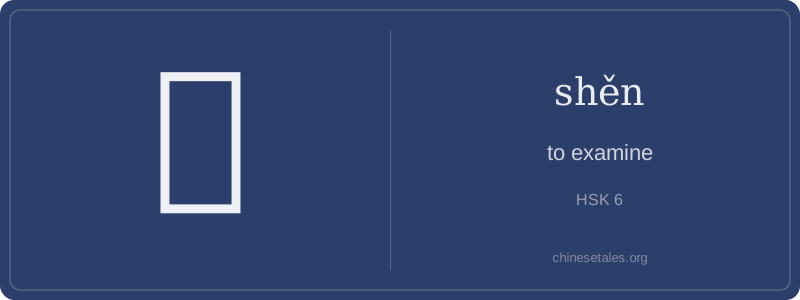
The earliest form of 审 appears in bronze inscriptions as a complex pictograph: a roof (宀) sheltering a person (人) holding a measuring tool or tally stick (申, which originally depicted lightning — symbolizing sharp, penetrating insight). Over time, the human figure simplified into the vertical stroke and dots we see today, while 申 evolved into the top-right component — retaining its phonetic role (shěn shares sound with 申) and semantic echo of ‘precision’. By the seal script era, 宀 + 申 was fully standardized: the roof framing careful, authoritative scrutiny beneath its protection.
This visual logic endured: in the Book of Rites (Lǐjì), officials were instructed to 审其事 ('examine the matter thoroughly') before reporting to the ruler — linking the character’s structure to governance. The roof (宀) suggests institutional space — courtrooms, editorial offices, audit departments — where scrutiny must be structured, impartial, and consequential. Even today, the eight strokes feel deliberate: four for the roof, four for the ‘investigation’ below — a perfect balance of shelter and scrutiny.
At its core, 审 (shěn) isn’t just ‘to examine’ — it’s to examine *with authority, care, and consequence*. Think of a judge scrutinizing evidence, a scholar verifying ancient texts, or an editor checking every comma before publication. It implies rigor, judgment, and responsibility — never casual looking. Unlike 看 (kàn, 'to look') or 观察 (guānchá, 'to observe'), 审 carries weight: you 审案子 (shěn ànzi, 'try a case'), 审稿 (shěn gǎo, 'review a manuscript'), or 审核 (shěn hé, 'audit'). It’s almost always transitive and formal — you rarely say ‘I examined the flower’ with 审.
Grammatically, 审 appears most often as the first verb in compound verbs (审阅, 审查, 审定), and in bureaucratic, legal, or academic contexts. Learners mistakenly use it for everyday observation — but no one 审 their breakfast. Also, note its tone: shěn is third tone, not shēn (first) or shèn (fourth); mispronouncing it risks sounding like ‘body’ (身) or ‘careful’ (慎), both dangerous slips in formal speech.
Culturally, 审 reflects China’s deep-rooted emphasis on verification before action — from imperial civil service exams (where essays were 审阅 by senior scholars) to today’s AI content moderation teams that must 审核 every livestream. A common error is overusing it in spoken Chinese; natives prefer 查 (chá) or 检查 (jiǎnchá) for routine checks. And crucially: 审 is never used reflexively — you don’t ‘examine yourself’ with 审; for self-reflection, use 反省 (fǎnxǐng).