寸
Character Story & Explanation
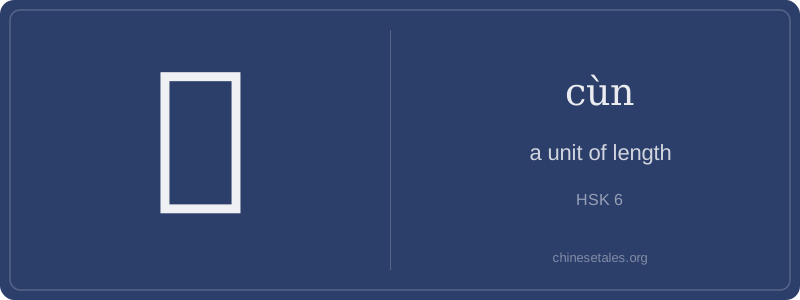
The earliest form of 寸 appears in late Shang oracle bone inscriptions as a simple hand (又 yòu) with a short horizontal stroke across the base of the thumb — literally marking 'the thumb-width'. By the Zhou bronze script era, the hand evolved into the radical ⺅ (a stylized 'hand' variant), and the horizontal stroke solidified into the distinctive dot-and-horizontal-bar shape we see today: the dot represents the pulse point on the wrist, and the horizontal bar marks the one-cùn distance from the wrist crease upward. The third stroke — the vertical hook — emerged later as a calligraphic flourish anchoring the unit visually to the body.
This wasn’t just measurement — it was medicine and metaphysics. In the Huangdi Neijing (Yellow Emperor’s Classic of Internal Medicine, c. 3rd century BCE), 寸 became the foundational unit for diagnosing pulse quality at the radial artery: the area from the wrist crease to the first finger joint is the 'cùn position', governing the Lung and Pericardium. Thus, 寸 transformed from a carpenter’s thumb-rule into a diagnostic threshold — where anatomy, time, and qi intersected. Even today, TCM practitioners feel for changes 'within the inch' — making 寸 one of the few Chinese characters that measures both space and spirit.
Think of 寸 (cùn) as China’s answer to the inch — but with far more personality. Unlike the sterile, standardized inch defined by a metal bar in London, the cùn began as a living, breathing human measurement: the width of a thumb at the knuckle. That warm, organic origin still pulses through its modern usage — it’s not just dry metrology, but a character that shows up in idioms like 寸步难行 (cùn bù nán xíng, 'can’t take even an inch forward'), where it conveys visceral, almost claustrophobic constraint. It feels intimate, bodily, and stubbornly human.
Grammatically, 寸 is a measure word you’ll rarely use alone — it’s almost always paired with numbers and classifiers like 分 (fēn) or 尺 (chǐ) in compound units (e.g., 三寸舌 sān cùn shé, 'a three-inch tongue' = razor-sharp wit). Crucially, it never stands in for 'inch' in technical English-style conversions (don’t say *一寸=2.54厘米* in speech — native speakers say 约2.5厘米); instead, it lives in fixed expressions, poetic metaphors, and traditional medicine (e.g., 寸口 cùn kǒu, the radial pulse point measured 'one cùn' from the wrist crease).
Culturally, learners often misapply 寸 as a generic 'small amount' — but it’s never abstract like 'a bit' or 'a tad'. It’s always spatial, precise, and rooted in the body or classical standards. Confusing it with 公分 (gōngfēn, 'centimeter') is common, but 寸 carries centuries of Daoist cosmology and acupuncture theory — it’s less about length and more about the calibrated space where life-force flows.