尖
Character Story & Explanation
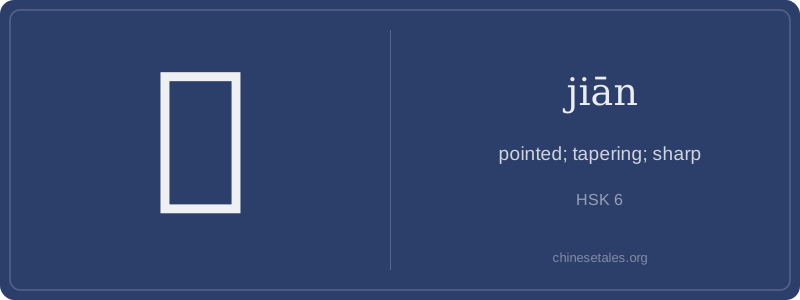
The earliest form of 尖 appears in bronze inscriptions as two small dots (小) stacked vertically — not yet the modern 小 + 大, but a pictograph of *two converging points*, like twin mountain peaks or intersecting spear tips. Over centuries, scribes stylized the upper dot into the radical 小 (‘small’), and the lower element evolved from a simplified ‘big’ (大) shape — not meaning ‘large’, but visually echoing the broad base narrowing to a point, like an inverted triangle. By the Han dynasty, the six-stroke structure 小 + 大 was fixed: two small strokes atop three broader ones, forming an unmistakable visual arrowhead.
This visual logic became semantic truth: the top 小 represents the tiny, focused apex; the bottom 大 suggests the solid, grounded base from which the point emerges. In classical texts, 尖 appears in medical treatises describing ‘sharp’ pulses (尖脉 *jiān mài*) and in poetry evoking piercing birdcalls (尖音 *jiān yīn*). The character never meant ‘aggressive’ — its power lies in *controlled concentration*, like the tip of a chisel carving jade: force held in perfect, minimal focus.
At its core, 尖 isn’t just ‘pointed’ — it’s the Chinese eye for *precision of extremity*: the very tip of a needle, the highest note in a soprano’s range, the sharpest edge of a debate. It carries a quiet intensity — not aggression, but *focused acuity*. You’ll rarely see it alone; it almost always modifies nouns (尖端, 尖叫) or functions as a stative verb meaning ‘to pierce through with precision’ (如芒在背, though 尖 itself doesn’t appear there — it’s the *idea* that underlies such idioms).
Grammatically, 尖 is versatile but subtle: as an adjective, it follows the noun in compounds (刀尖 *dāo jiān*, ‘knife tip’) but precedes it when standalone (尖牙 *jiān yá*, ‘sharp fang’); as a verb, it appears in literary or poetic contexts (尖声喊叫 *jiān shēng hǎn jiào*, ‘shriek shrilly’). Learners often overuse it like English ‘sharp’, forgetting that Chinese prefers context-specific terms — e.g., 铝箔很薄 (*bó*) not *jiān*, and ‘sharp mind’ is 敏锐 (*mǐn ruì*), not 尖.
Culturally, 尖 hints at a deep aesthetic reverence for *the culmination point* — think of the upward flick of a Song dynasty roof corner, the final brushstroke in calligraphy, or the ‘peak’ of a career (尖子生 *jiān zi shēng*, ‘top student’). Mispronouncing it as *jiǎn* (a common tone slip) won’t break comprehension, but it subtly erases the character’s energetic, upward-thrusting quality — this is a word that *rises*, both in tone and in shape.