尬
Character Story & Explanation
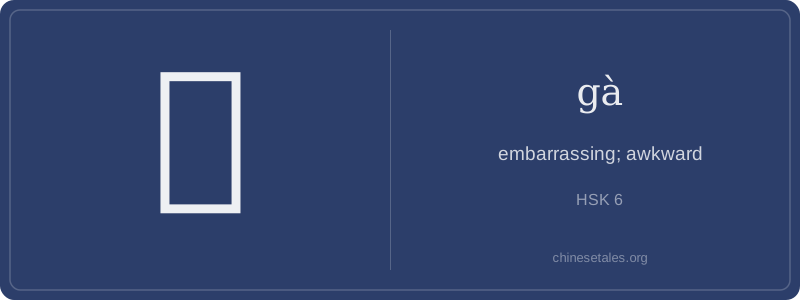
The character 尬 first appeared in late Han dynasty texts and evolved from a compound pictograph: the left side 尢 (wāng) — originally a stylized depiction of a limping or disabled person (bent leg, asymmetrical stance) — combined with the right side 介 (jiè), meaning ‘to intervene’ or ‘to separate’. In early clerical script, 尤 looked like a figure with one leg bent unnaturally; 介 resembled two crossed lines symbolizing division or boundary. Together, they visually suggested ‘a person caught between states — neither fully standing nor sitting, neither accepted nor rejected’.
This physical image crystallized into a psychological state by the Tang dynasty: the *Guangyun* rhyme dictionary (1008 CE) defined 尬 as ‘bù dé qí suǒ’ — ‘not finding one’s proper place’. By Ming-Qing vernacular fiction (e.g., *The Plum in the Golden Vase*), 尬 had fully merged with 尴 to form 尴尬, describing social stumbles so vivid they became literary shorthand for moral or ritual misalignment — like a guest refusing tea before the host offers it. The modern 7-stroke form preserves this tension: the crooked 尢 anchors the character, while 介’s sharp, angular strokes feel like an ill-fitting piece jammed beside it — a perfect visual echo of its meaning.
Think of 尬 (gà) as the linguistic equivalent of a cringe-worthy pause — that visceral, stomach-dropping feeling when you realize you’ve just said something wildly inappropriate, worn mismatched socks to a job interview, or accidentally waved back at someone who wasn’t waving at you. It’s not just ‘embarrassing’ in the dictionary sense; it’s deeply interpersonal, socially charged, and often involuntary — a shared moment of collective discomfort that makes native speakers wince and laugh simultaneously.
Grammatically, 尬 is almost never used alone. You’ll rarely see it as a standalone adjective like ‘awkward’ in English. Instead, it thrives in reduplicated forms (尷尬 / gān gà) or compounds — especially 尴尬 (gān gà), which functions as an adjective, verb, or even noun. Note: 尴尬 is *always* written with both characters — 尬 alone doesn’t appear in modern standard usage outside dictionaries or stylistic abbreviations (like internet slang). Learners sometimes try to say ‘tā hěn gà’ — but that’s unnatural; it’s always ‘tā jué de hěn gān gà’ or ‘zhè ge qíng kuàng hěn gān gà’.
Culturally, 尬 carries a uniquely Chinese flavor of social face (miànzi) awareness. It’s less about personal shame and more about disrupted harmony — a misstep in the delicate choreography of polite interaction. Western learners often overuse it for mild discomfort (e.g., ‘I’m a little awkward in crowds’), but 尴尬 implies a specific, observable social rupture — think tripping while bowing, mispronouncing your boss’s name *twice*, or realizing your Zoom background is off… during a salary negotiation.