岔
Character Story & Explanation
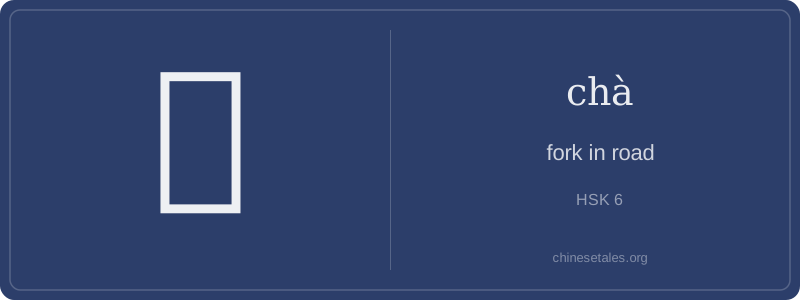
The earliest form of 岔 appears in seal script as 山 (mountain) above two parallel diagonal strokes slanting outward like arms spreading — a stylized depiction of mountain paths splitting apart. Over time, those strokes simplified into the modern ‘分’-like top: two short, angled strokes (丷) over a horizontal line (一), all sitting atop 山. The radical 山 isn’t decorative — it anchors the character in terrain, signaling this is about *geographic* divergence, not abstract division. Stroke order reinforces this: first the mountain frame (丨、、丶), then the branching strokes (丷 + 一) — nature first, then human encounter with choice.
By the Han dynasty, 岔 appeared in texts like the *Shuōwén Jiězì* as ‘branching mountain roads,’ later broadening to any decisive split — rivers, arguments, even political factions. In Ming novels, ‘岔言’ meant ‘a contradictory remark,’ showing how early the meaning extended to semantic divergence. Its visual logic is elegant: 山 grounds it in landscape; the top half mimics the V-shape of a real fork — no curves, no softness, just clean, consequential angles.
Imagine you’re hiking in the misty mountains of Sichuan, and suddenly the trail splits — not just two paths, but three: one winds up the pine-covered slope, another vanishes into bamboo groves, and the third dips down toward a rushing stream. That moment of indecision, that physical Y-shaped divergence? That’s 岔 (chà) — not just ‘a fork,’ but *the* fork: sharp, sudden, consequential. In Chinese, 岔 carries weight — it implies a meaningful division where choice matters, not just a casual branching. You’ll hear it in road signs (‘岔路口’), navigation apps, and even metaphorically when plans diverge.
Grammatically, 岔 rarely stands alone. It’s almost always part of a compound: 岔路 (chà lù, ‘forked road’), 岔道 (chà dào, ‘diverging path’), or the verb 岔开 (chà kāi, ‘to diverge’). Crucially, it’s *not* used for abstract ‘branches’ like in computer science (that’s 分支 fēnzhī); nor is it interchangeable with 叉 (chā), which refers to crossing or X-shaped intersections. Learners often mistakenly say ‘叉路’ — a non-word that sounds plausible but triggers blank stares from native speakers.
Culturally, 岔 evokes classical travel poetry and Daoist imagery of life’s turning points — think of Wang Wei’s quiet roads where ‘山重水复疑无路,柳暗花明又一村’ hints at the very uncertainty a 岔 embodies. A common slip is overgeneralizing it to any junction; remember: 岔 implies *separation*, not *crossing*. Also, note its tone — chà (fourth tone) rhymes with ‘ah!’ — the sound you make when you stop short at that unexpected split in the trail.