岩
Character Story & Explanation
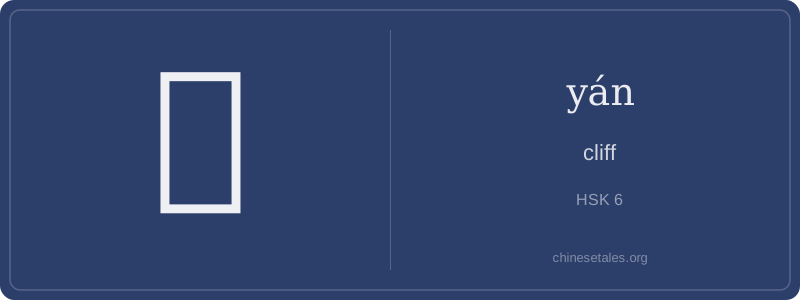
The earliest form of 岩 appears in bronze inscriptions as 山 + 严 (a simplified variant of 嚴, meaning ‘strict’ or ‘imposing’), but oracle bone precursors show a mountain (山) with jagged, layered strokes beneath—like strata exposed by erosion. Over time, the lower part condensed into the modern 严 component: three horizontal lines (representing layers of rock) topped by a ‘lid’ (the 一 and 丨), suggesting compression and density. The radical 山 remains proudly atop, anchoring the character visually and semantically in the realm of mountains and earth.
By the Han dynasty, 岩 shifted from purely descriptive to evocative: in the Classic of Mountains and Seas (Shānhǎi Jīng), it names legendary cliffs guarding immortal realms—places where stone breathes and echoes hold wisdom. Poets like Du Fu used 岩 to signal moral fortitude: ‘my loyalty stands as firm as cliff-rock’ (忠心如岩). Its visual duality—mountain above, compressed strata below—mirrors the Chinese worldview: surface grandeur rests on deep, unseen structure.
At its heart, 岩 (yán) isn’t just a geological term—it’s a sensory and philosophical anchor. In Chinese, it evokes raw, unyielding stillness: the cool weight of stone against skin, the echoless silence of a high cliff face, the slow, tectonic patience of mountains. Unlike English ‘cliff’, which emphasizes vertical drop, 岩 carries connotations of *mass*, *texture*, and *endurance*—it’s the cliff *as substance*, not just shape. You’ll rarely see it standalone in speech; it’s almost always embedded in compounds (e.g., 岩石, 岩浆) or poetic descriptions.
Grammatically, 岩 functions primarily as a noun or morpheme, never as a verb or adjective. Learners often mistakenly try to use it like ‘rock’ in English (“I rock climb!”), but you’d say 攀岩 (pān yán)—literally ‘climb cliff’, where 岩 is an inseparable object noun. It also appears in fixed classical phrases like 悬崖峭壁 (xuán yá qiào bì), where 崖 and 壁 both mean ‘cliff/face’, but 岩 implies the *bedrock foundation* beneath them—subtle, but vital.
Culturally, 岩 embodies Daoist reverence for natural permanence and Chan Buddhist metaphors for unwavering mind (e.g., 心如磐岩 — ‘mind like solid rock’). A common mistake? Confusing it with 岩 vs. 崖 (yá, ‘precipice’) — one is the *material*, the other the *edge*. Also, don’t read 岩 as ‘rock’ in casual contexts: for a pebble or gravel, use 石 (shí); 岩 is for geologic scale, drama, and depth.