崖
Character Story & Explanation
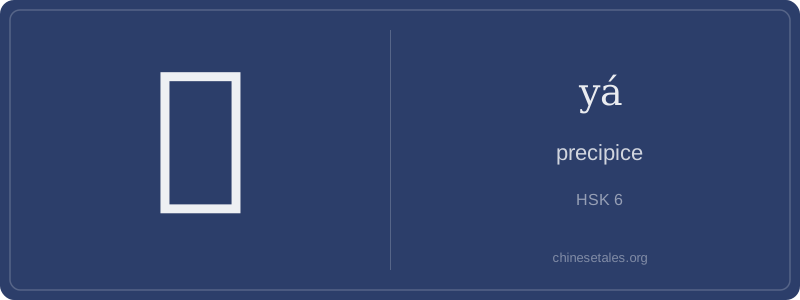
The earliest form of 崖 appears in bronze inscriptions as a pictograph showing a mountain (山) with jagged, downward-pointing rock strata — like teeth biting into empty space — and a simplified 'yá' phonetic component emerging later. Over time, the top evolved into the modern 山 radical (three peaks), while the lower part solidified into 卩 (jié), a seal-like glyph representing a human figure or boundary marker, and the right side became 厂 (hǎn), a cliff-face ideograph itself — making 崖 a rare triple-layered character: semantic (mountain), semantic (cliff), and phonetic (yá sound from 厂 + 卩).
This visual stacking reflects its meaning perfectly: not just height, but *unstable height* — a geologically abrupt termination. By the Han dynasty, 崖 appears frequently in texts like the *Shuōwén Jiězì*, defined as 'the steep edge of a mountain'. In Tang poetry, it shifted from pure geography to psychological metaphor: Du Fu wrote of 'my heart hanging over the cliff' (心悬绝崖) to convey unbearable tension. Its shape — sharp, asymmetrical, leaning — mirrors how it feels to stand there: no room for error, no soft landing.
Imagine standing at the edge of Huashan Mountain in Shaanxi — wind whipping your hair, heart pounding as you peer down a sheer, jagged drop where mist swallows the bottom whole. That vertigo-inducing, awe-struck moment? That’s 崖 (yá) — not just any hillside, but a *sheer*, often vertical, rocky precipice. It evokes danger, majesty, and solitude all at once; it’s never gentle or gradual. In Chinese, 崖 is almost always a noun, appearing in place names (泰山南崖 Tàishān Nán yá — 'South Precipice of Mount Tai'), poetic imagery ('cliff-face' metaphors for resolve or isolation), and fixed compounds — but almost never as a verb or adjective.
Grammatically, it rarely stands alone: you’ll see it in compounds like 悬崖 (xuán yá — 'overhanging cliff') or 悬崖勒马 (xuán yá lè mǎ — 'rein in one’s horse at the cliff’s edge', i.e., 'to stop just before disaster'). Learners sometimes mistakenly use 崖 for any slope or bank — but that’s 滩 (tān) for riverbank, or 坡 (pō) for hillside. 崖 implies geological drama: bare rock, near-verticality, and existential exposure.
Culturally, 崖 carries Daoist and Chan Buddhist resonance — cliffs symbolize the razor’s edge between delusion and awakening, life and death. Classical poets like Li Bai used it to express both peril and transcendence ('Cliff shadows swallow the sun' — 悬崖日影沉). A common mistake? Confusing it with 涯 (yá), which sounds identical but means 'shore' or 'end of the horizon' — same pinyin, totally different radical (氵 vs. 山) and world.