岗
Character Story & Explanation
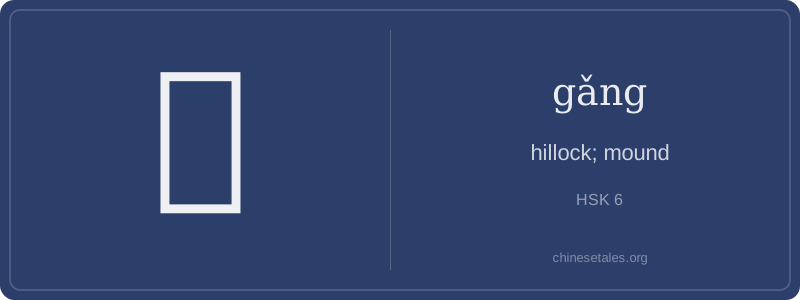
The earliest form of 岗 appears in bronze inscriptions as a simplified variant of 岡 (gāng), which itself was a pictograph showing two mountain peaks (山) flanking a ridge line—like a double-humped camel silhouette. Over time, the right side evolved from 巛 (a flowing water symbol, later stylized) into 冈, then further simplified during clerical script reforms to just 冋 (jiǒng), a square enclosure representing a bounded, elevated area. By the Song dynasty, the modern 岗 emerged: 山 (mountain radical) + 冋 (enclosed space), visually suggesting ‘a defined, raised place within mountainous terrain’.
This visual logic held steady through history: in the Shuō Wén Jiě Zì (121 CE), 岡 was defined as ‘a long, continuous ridge’, and 岗 inherited that sense of modest, linear elevation—not a towering peak, but a strategic rise. Classical poets like Du Fu used 岡 to evoke quiet resilience (e.g., ‘the old man climbs the ridge at dawn’), reinforcing its association with endurance and vantage. Even today, the character’s shape whispers: ‘mountain’ + ‘bounded space’ = a place you stand to see farther—not because you’re high, but because you’re precisely placed.
Think of 岗 (gǎng) as China’s linguistic version of a 'knoll'—not quite a hill, not quite a hilltop, but that gentle, grassy rise you’d spot on a pastoral English landscape painting. In Chinese, it evokes quiet elevation: modest, natural, and often solitary—like a sentry post perched on a low swell of land. It’s rarely used alone today; instead, it anchors compound words where height, position, or vigilance matters—especially in military, geographical, or bureaucratic contexts.
Grammatically, 岗 is almost always bound: you won’t say *‘this is a gǎng’* like ‘this is a hill’. Instead, it appears in nouns like 岗位 (gǎngwèi, ‘job position’) or 岗哨 (gǎngshào, ‘sentry post’). Notice how the ‘position’ sense extends metaphorically from physical elevation to social function—a subtle but crucial semantic leap. Learners often misread it as ‘gang’ (like English ‘gangster’), but the tone is third (gǎng), not first—and more importantly, its meaning has zero criminal connotation.
Culturally, 岗 carries an unspoken dignity: it’s the mound where a watchman stands, the slight rise where a village boundary marker sits, the quiet prominence that commands without shouting. A common mistake is overgeneralizing it to mean any ‘hill’—but 岭 (lǐng), 峰 (fēng), and 坡 (pō) cover steeper, higher, or sloped terrain. 岗 is humble elevation—modest, functional, and deeply rooted in China’s topography of observation and duty.