廓
Character Story & Explanation
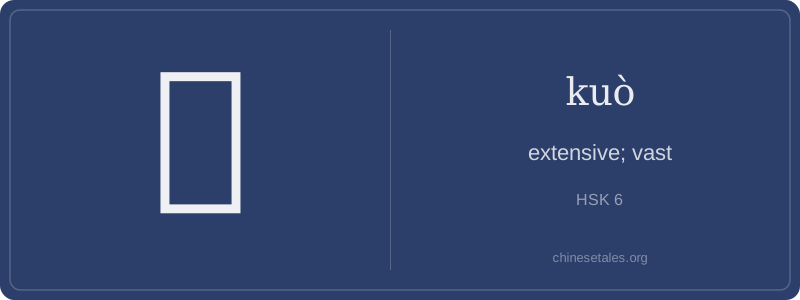
The earliest form of 廓 appears in bronze inscriptions as a combination of 广 (a roof-like radical suggesting shelter or space) and 郭 (guō), which itself depicts a walled city — with ‘邑’ (city) on the right and ‘享’-like elements hinting at ceremonial enclosure. Over time, the right side simplified into 郭’s phonetic core (郭 → 郭 → 廓), while 广 remained steadfast as the semantic anchor. Notice how the 13 strokes trace a deliberate path: the wide, open top stroke of 广 (3 strokes) frames the inner complexity — like a roof over a detailed map of walls and gates.
By the Han dynasty, 廓 had crystallized its dual role: as a noun meaning ‘outer wall’ or ‘perimeter’, and as a verb meaning ‘to outline’. In Du Fu’s poetry, he writes of mountains whose 廓影 (kuò yǐng, ‘contour shadows’) stretch across misty valleys — treating the silhouette not as absence, but as a tangible boundary drawn by light. The character’s visual architecture mirrors its meaning: the expansive 广 radical literally *holds* the precision of 郭 — vastness given shape, emptiness made meaningful through edges.
Picture a vast, open courtyard stretching beyond the walls of an ancient hall — that’s the visceral feeling of 廓 (kuò). It doesn’t just mean ‘vast’ in an abstract way; it evokes spatial expansiveness *with boundaries*: the outer rim of a city wall, the perimeter of a temple compound, or the sweeping edge of a mountain range. This isn’t empty infinity — it’s defined openness, like the frame around a landscape painting. Native speakers instinctively sense this nuance: you’d say 廓大 (kuò dà) to praise a person’s broad-mindedness — literally ‘spatially large’ — but never use it for sheer size like a giant watermelon (that’s 大 or 巨大).
Grammatically, 廓 is almost never used alone. It’s a literary, high-register character that thrives in compound nouns (e.g., 轮廓, 廓清) or as a verb meaning ‘to define clearly’ — think of sketching the outer lines of a shape. Learners often mistakenly treat it like a simple adjective (e.g., *这个房间很廓*), but that’s ungrammatical and jarring. Instead, it appears in set phrases: 廓清 (kuò qīng) means ‘to clarify thoroughly’, as if wiping away fog from the horizon line.
Culturally, 廓 carries classical gravitas — it appears in Tang poetry and Neo-Confucian texts describing moral clarity or cosmic order. Modern usage leans poetic or technical (e.g., image processing: 轮廓识别). A classic pitfall? Confusing it with 扩 (kuò), which means ‘to expand’ and shares the sound but not the spatial-boundedness. If you say 扩大 instead of 廓清, you’ve shifted from ‘clarifying boundaries’ to ‘making something bigger’ — a subtle but critical semantic rift.