庙
Character Story & Explanation
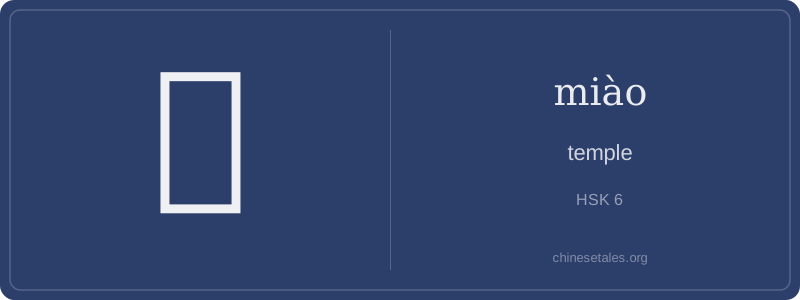
The earliest form of 庙 appears in bronze inscriptions of the Western Zhou (c. 1046–771 BCE), not as a pictograph of a building, but as a stylized depiction of an ancestral hall: a wide roof (the radical 广, representing shelter) over a simplified ‘shrine’ element — originally resembling two stacked ‘mouths’ (口口) symbolizing offerings or ritual chanting, later evolving into 由. By the seal script era, the top became 广 (a broad, overhanging roof), and the bottom solidified into 由 (yóu), which phonetically anchors the reading while visually suggesting a sacred space ‘through which’ spirits enter.
This character’s evolution mirrors China’s ritual history: early 庙 were exclusively ancestral halls for noble clans, enshrining tablets—not statues—of deceased forebears. Confucius wrote in the Analects (3.12) that ‘The sacrifice of the people should not be performed in the ancestral temple of another clan’ (mín bù yùn yú tā zú zhī miào), stressing lineage-bound sanctity. Only later did 庙 broaden to include deities and folk gods. Its enduring 广 radical reminds us: this is first and foremost *sheltered sacred space*—not architecture as art, but architecture as covenant between the living and the remembered.
At its heart, 庙 (miào) isn’t just ‘temple’ in the Western architectural sense—it’s a living node of spiritual and social continuity. In Chinese, it evokes reverence, ancestral presence, and localized sacred geography: you don’t just visit a 庙—you *pay respects* (bài miào), seek blessings (qiú fú), or honor a deity *as part of a community*. Unlike English ‘temple’, which often implies formality or exclusivity, 庙 can be humble—a roadside shrine to the Earth God (Tǔdì Miào) or even a family altar tucked into a courtyard.
Grammatically, 庙 is a noun that rarely stands alone; it almost always appears in compounds (lóngwáng miào, chéng huáng miào) or with verbs like yǒu (‘there is’), jiàn (‘to build’), or bài (‘to worship’). Learners often mistakenly use it for churches or mosques—those are always 教堂 (jiàotáng) or 清真寺 (qīngzhēnsì), never 庙. Also, note: 庙 doesn’t take measure words like 一座 (yī zuò) unless specifying structure—‘a temple’ is usually just 一座庙, but in classical or poetic usage, you might hear 庙宇 (miàoyǔ) for emphasis on grandeur.
Culturally, 庙 carries layers of folk religion, Confucian ritual, and local identity. A village without a 庙 feels spiritually unmoored—and many still hold annual temple fairs (miàohuì), where incense smoke, opera troupes, and sticky rice cakes mingle. A common learner trap? Over-translating ‘temple’ in Buddhist contexts: while some Buddhist sites are called 庙 (e.g., 少林寺 is also 少林庙 colloquially), the formal term is always 寺 (sì). Using 庙 for a major monastery can subtly imply informality—or even irreverence.