弊
Character Story & Explanation
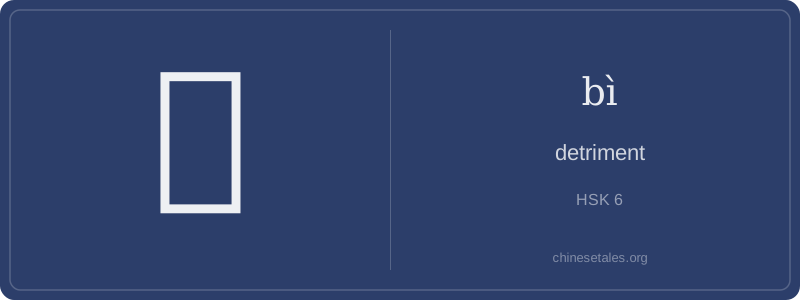
The earliest form of 弊 appears in Warring States bamboo texts — not as a pictograph, but as a phonosemantic compound: 上 (shàng, 'above') + 廾 (gǒng, 'hands cupped together') + 攵 (pū, 'hand holding a stick') — all wrapped around 币 (bì, 'currency', now written as 幣). But here’s the twist: the 'currency' part was originally 貝 (bèi, 'cowrie shell'), symbolizing value — and the hands and stick implied *manipulation*. So the character literally meant 'falsifying value with deceitful hands'. Over centuries, the 貝 simplified into 敝 (bì, 'worn-out'), linking decay to corruption — and the modern form solidified with 廾 (two hands) at the bottom, evoking hidden collusion.
This visual logic shaped its meaning: from 'tampering with currency' in Han legal texts to 'abuse of power' in Tang dynastic histories. By the Ming era, scholars used 弊 in essays condemning exam cheating — calling it 科举之弊 ('the ills of the imperial examination system'). Even today, the radical 廾 (two hands) subtly reminds us: 弊 isn’t accidental — it’s human-made, often collaborative, and always rooted in distorted intent.
Think of 弊 (bì) as Chinese for 'the hidden tax on everything' — not money, but the invisible drag of inefficiency, corruption, or systemic rot. It’s not just 'bad' or 'harmful'; it’s the *structural flaw* that undermines a good idea: like a brilliant policy doomed by bureaucratic red tape, or a well-intentioned reform derailed by entrenched interests. In English, we’d say 'downside', 'drawback', or 'loophole', but 弊 carries sharper moral weight — it implies culpability, not just misfortune.
Grammatically, 弊 rarely stands alone; it’s almost always in compound nouns (e.g., 弊端, 弊病) or as the object of verbs like 暴露 (bào lù, 'to expose') or 杜绝 (dù jué, 'to eradicate'). You’ll never say 'this is 弊' — you say 'this system has serious 弊端'. Learners often mistakenly use it as an adjective ('a 弊 plan'), but it’s strictly a noun — and only in formal, critical contexts (never casual speech).
Culturally, 弊 is a quiet powerhouse in political and academic discourse: China’s anti-corruption campaigns constantly reference 扫除腐败和各种弊病 ('eradicating corruption and all kinds of ills'). A classic mistake? Confusing it with 碧 (bì, 'jade-green') — same sound, totally different universe. Also, don’t overuse it: saying 'every policy has 弊' sounds cynically dismissive, not analytically sharp. Reserve it for deep, systemic flaws — not minor inconveniences.