弦
Character Story & Explanation
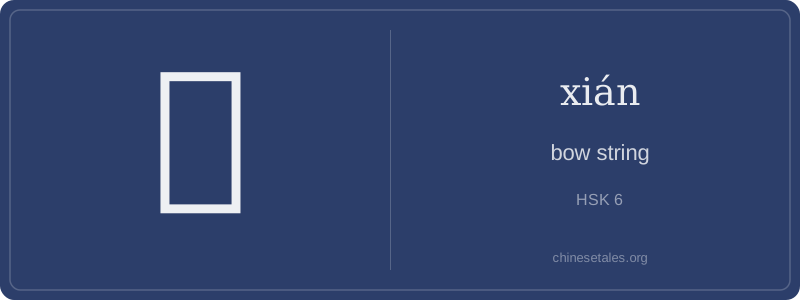
The earliest form of 弦 appears in bronze inscriptions as a stylized bow (弓) with two parallel horizontal lines across its curve—depicting the string stretched taut between the bow’s ends. Over time, those lines simplified into the two short horizontal strokes inside the modern 弦, while the left side remained the full 弓 radical. By the seal script era, the character had settled into its current structure: 弓 (radical, meaning 'bow') + 玄 (phonetic component, *xuán*, later adapted to *xián* via sound shift). Note how the two tiny horizontals visually echo the string’s tightness—like a bow held at full draw.
This visual logic shaped its meaning evolution: from literal bowstring → instrument string (as early as the *Book of Songs*, where 'plucking the zither’s strings' evokes ritual harmony) → abstract 'tension' (e.g., 紧张的弦 *jǐnzhāng de xián*, 'taut string' as a metaphor for anxiety). The phonetic element 玄 also carried connotations of 'profound' or 'subtle', reinforcing 弦’s association with deep, resonant effects—not just noise, but meaning that vibrates within you.
Imagine an ancient archer in the Zhou dynasty drawing his bow—tense, silent, the *xián* (bow string) humming with latent power just before release. That taut vibration is the soul of 弦: it’s not just a physical cord, but the source of tension, resonance, and potential energy. In modern Chinese, 弦 keeps this core idea alive—not only as 'bow string' (e.g., 拉弓弦 *lā gōng xián*, 'to draw the bowstring'), but more vividly as 'string' on musical instruments (琴弦 *qín xián*, 'guqin string') and even metaphorically for emotional or psychological tension (心弦 *xīn xián*, 'heartstrings').
Grammatically, 弦 is almost always a noun, rarely used alone—it appears in compound nouns or with classifiers like 根 (*gēn*, 'a slender object'). Learners often mistakenly treat it as a verb ('to string') or confuse it with homophones like 闲 (*xián*, 'leisure'); remember: 弦 *always* implies something stretched, resonant, or taut. You’ll see it in scientific terms too—like 弦理论 (*xián lǐlùn*, 'string theory')—where physicists borrowed its ancient sense of fundamental vibrating filaments.
Culturally, 弦 carries poetic weight: Confucius praised music that 'touches the heartstrings' (动人心弦 *dòng rén xīn xián*), linking moral cultivation to sonic resonance. A common error? Using 弦 for 'wire' or 'cable'—that’s 线 (*xiàn*), which looks similar but belongs to a different semantic world. Think: 弦 = *vibrating* string; 线 = *static* line.