御
Character Story & Explanation
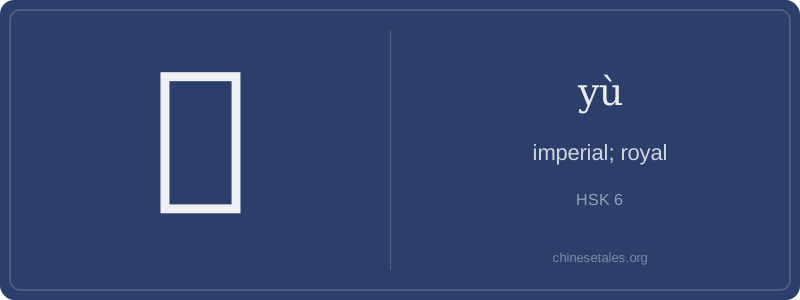
The earliest form of 御 appears in Western Zhou bronze inscriptions as a composite pictograph: a left-side '彳' (walking radical) + a right side showing a hand (又) guiding a chariot horse (represented by 矣 or similar early forms). It literally depicted 'controlling a chariot while moving' — the king or noble steering his war chariot into battle. Over centuries, the horse element simplified and merged; the 'hand' evolved into '卸' minus the 'qu' component, and the walking radical 彳 stabilized on the left. By the seal script era, the 12-stroke structure we know today was fixed — a walking man (彳), a 'meat/flesh' component (月, originally 豕 'pig' but later conflated with 月), and a 'hand' (又) above — all coalescing into 'commanding movement with authority.'
This chariot-driving origin explains everything: 御 wasn’t just 'ruling' — it was *direct, hands-on, mobile sovereignty*. In the Book of Rites, 御 appears in passages about proper conduct 'before the imperial presence' (御前), where even posture was regulated as part of ruling mechanics. Confucius praised rulers who '御民以道' — governing the people with the Way, likening ethical leadership to skilled charioteering. The character’s enduring power lies in this fusion: physical control, moral legitimacy, and forward motion — all rolled into one elegant, authoritative stroke sequence.
Think of 御 (yù) as Chinese royalty’s ‘royal seal’ — not just an adjective like 'imperial,' but a verb with gravitas, like 'to wield sovereign authority' or 'to command with divine mandate.' Unlike English adjectives that sit quietly before nouns (e.g., 'imperial palace'), 御 is often a *verb* — it implies active, legitimate control: 御驾亲征 (the emperor personally leads troops), 御笔 (the emperor’s own brushstroke — a decree in ink). It carries the weight of legitimacy: only the Son of Heaven could truly 御 something.
Grammatically, it appears in formal, literary, or historical contexts — rarely in casual speech. You’ll see it in compound verbs (御寒 'to ward off cold'), honorific nouns (御用 'imperially appointed'), and classical set phrases. Learners often mistakenly use it as a standalone adjective ('this is imperial') — but 御 alone doesn’t mean 'imperial'; it needs context or compounding (e.g., 御用 ≠ 'imperial use' but 'appointed by the emperor'). It’s never used for modern institutions ('imperial university' is not *御大学* — that would sound absurdly archaic).
Culturally, 御 evokes the Mandate of Heaven: to 御 is to rule *by cosmic right*, not mere power. That’s why it’s embedded in terms like 御前 (‘before the imperial presence’) — a space where status, protocol, and divine sanction converge. A common slip is confusing it with 易 (yì) or 卸 (xiè); both share visual echoes but zero semantic overlap. And no — you can’t say '御咖啡' for 'royal coffee.' That’s not how this character rolls.