怖
Character Story & Explanation
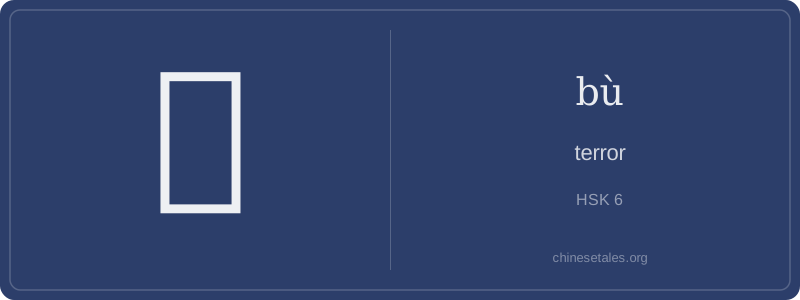
The earliest form of 怖 appears in bronze inscriptions as a combination of 心 (xīn, 'heart') and 布 (bù, originally depicting 'spreading cloth' but phonetically borrowed here). In oracle bone script, there was no standalone 怖—but by the Warring States period, scribes fused the 'heart-mind' radical 忄 (a cursive variant of 心) with 布 as a phonetic component. Visually, the left side 忄 signals emotion; the right side 布 (8 strokes total) provides pronunciation—and subtly echoes 'spreading' or 'unfolding', as if terror spreads through the body like fabric unfurling.
This visual metaphor deepened over time: in the Han dynasty, 怖 began appearing in medical texts describing 'qi stagnation from sudden fright', and in the Zhuangzi, it’s used to depict the primal shock of confronting cosmic vastness. By the Tang, poets wielded 怖 not for jump-scares but for existential awe—e.g., '万籁俱寂,唯余怖意' ('All sounds stilled—only terror remained'). The character’s calm stroke order (left-to-right, fluid yet controlled) ironically mirrors how terror often arrives silently, then detonates inward.
Think of 怖 (bù) not as generic 'fear' but as a visceral, paralyzing terror—the kind that freezes your breath and makes your heart hammer against your ribs. It’s stronger than 害怕 (hàipà) and far more intense than 恐 (kǒng), which often appears in abstract or intellectual contexts (e.g., 恐惧症 'phobia'). 怖 carries literary weight and emotional gravity; it rarely appears alone in speech but shines in writing—especially in classical allusions, psychological descriptions, or horror-tinged narratives.
Grammatically, 怖 functions primarily as a noun ('terror') or an adjective ('terrifying'), almost always within compounds (like 恐怖 or 惊怖). You won’t say *'wǒ hěn bù'* — that’s ungrammatical and unnatural. Instead, you’ll see it in fixed phrases: 恐怖分子 (kǒngbù fènzǐ, 'terrorist'), 毛骨悚然 (máogǔsǒngrán, 'hair-raising terror'), or as the final element in literary adjectives like 悚怖 (sǒngbù, 'ghastly'). Its tone (bù, fourth tone) is sharp and falling—like a gasp cut short.
Culturally, 怖 evokes classical restraint: it appears in Tang poetry describing battlefield dread (e.g., Du Fu’s lines on war’s silent horror), and in modern usage, it’s deliberately elevated—avoided in casual talk to prevent sounding melodramatic or archaic. A common mistake? Confusing it with 布 (bù, 'cloth')—same sound, zero relation—and overusing it solo instead of relying on natural collocations. Remember: 怖 doesn’t shout—it chills.