怠
Character Story & Explanation
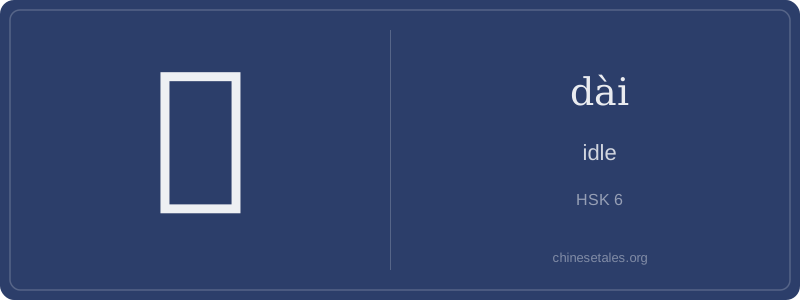
The earliest form of 怠 appears in bronze inscriptions as a compound: the top part resembled 台 (tái, a platform or terrace), and the bottom was 心 (xīn, 'heart/mind'). Over time, the top evolved into the modern 台-like component (but note: it’s not actually 台—it’s a phonetic loan shape), while the 心 radical stayed anchored at the bottom. Though it looks like a heart under a platform, there’s no architectural meaning—the 'platform' part was borrowed for its sound (tái → dài), and the 心 signaled that this laziness originates *internally*, from the mind’s attitude, not external circumstance.
This internalization is key: by the Warring States period, 怠 already appeared in texts like the *Zuo Zhuan*, describing officials who '怠于政事' (dài yú zhèngshì, 'neglected state affairs')—not because they were tired, but because their *xin* (heart-mind) had grown indifferent. The character thus crystallized an ancient insight: negligence isn’t passive; it’s an active withdrawal of attention and care. Even today, when a Chinese parent says '不要怠慢客人' (bùyào dài màn kèrén), they’re invoking centuries of social ethics—not just manners, but moral posture.
At its core, 怠 (dài) isn’t just ‘idle’ in the lazy-afternoon sense—it’s a morally weighted word that implies *negligence born of willful disengagement*, especially toward duty, respect, or responsibility. Think less 'napping on the couch' and more 'failing to greet your elder properly because you can’t be bothered.' In classical Chinese, it carried strong Confucian overtones: to 怠 one’s parents or ruler was a serious ethical lapse—not merely unproductive, but disrespectful.
Grammatically, 怠 is almost always used as a verb (rarely as an adjective), and it’s nearly always transitive: you 怠 something or someone—怠慢 (dài màn, 'to slight'), 怠工 (dài gōng, 'to slack off at work'), or 怠忽 (dài hū, 'to neglect carelessly'). You won’t say 'he is 怠'; instead, you say 'he 怠慢 his duties.' It never stands alone like English 'idle'—it demands an object, reinforcing the idea that idleness only becomes meaningful (and problematic) in relation to what you’re *supposed* to do.
Learners often misapply it as a synonym for 懒 (lǎn, 'lazy') or 松懈 (sōngxiè, 'lax'), but those lack 怠’s sharp connotation of *deliberate disregard*. Another trap: confusing 怠 with similar-looking characters (like 台 or 治). And crucially—don’t use it in casual self-deprecation ('I’m so 怠 today!'); it sounds oddly formal and slightly accusatory, like scolding yourself in classical court language.