悼
Character Story & Explanation
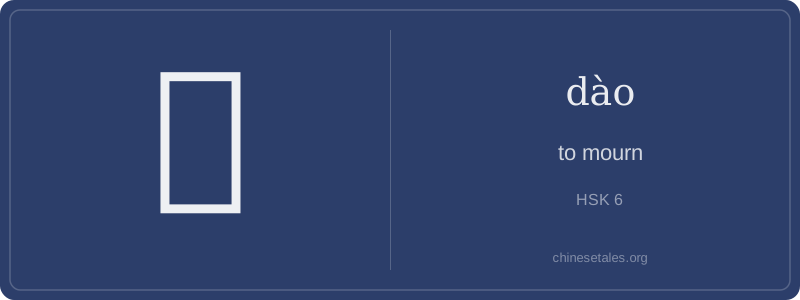
The earliest form of 悼 appears in Warring States bamboo slips and small seal script, where it combines 忄 (the ‘heart-mind’ radical, indicating emotion) with 卓 (zhuó), a phonetic component meaning ‘lofty, outstanding.’ Visually, 卓 itself evolved from a pictograph of a tall pole or banner — suggesting something elevated, prominent. In oracle bone script precursors, no direct pictograph survives, but bronze inscriptions show the heart radical paired with a simplified vertical stroke cluster representing height and distinction — hinting that early mourners didn’t just feel sorrow, but *lifted up* the memory of the departed.
By the Han dynasty, 悼 had crystallized into its modern structure: 忄 + 卓 — eleven strokes total. Classical texts like the Zuo Zhuan use it in phrases like ‘悼之深’ (dào zhī shēn — ‘deeply mourn’) to describe ritualized grief for nobles and elders. Crucially, the ‘loftiness’ of 卓 wasn’t about pride — it was about elevating the deceased’s virtue into collective memory. Even today, when you write 悼, you’re literally inscribing ‘heart + what rises above’ — a visual metaphor for honoring by lifting memory skyward.
At its heart, 悼 isn’t just ‘to mourn’ — it’s the quiet, dignified weight of grief held in reverence. Unlike casual words for sadness (e.g., 伤心), 悼 carries solemnity, formality, and often a public or ritual dimension: it’s used for state funerals, literary elegies, or honoring the deceased with respect — never for everyday disappointment or minor loss. Think of it as grief dressed in black silk, not sweatpants.
Grammatically, 悼 is almost always transitive and verb-only in modern usage — you 悼念 someone (‘mourn a person’), 悼亡 (‘mourn the dead’), or 悼词 (‘eulogy’) — but it rarely stands alone as a bare verb like ‘I mourn.’ You won’t say *‘Wǒ dào’* to mean ‘I’m mourning’; instead, it appears in compounds or with objects/objects + aspect particles: 他沉痛悼念恩师 (Tā chéntòng dàoniàn ēnshī — ‘He deeply mourned his mentor’). Learners often mistakenly use it where 悲伤 or 哀伤 would fit better — but 悼 implies intention, ritual, and moral gravity.
Culturally, this character embodies Confucian reverence for ancestors and the ethical duty of remembrance. Its presence in official documents, memorial inscriptions, and classical poetry signals continuity between life and memory — not just feeling sorrow, but performing respect. A common error? Using 悼 for personal, raw grief — which sounds stiff or even inappropriate. Reserve it for when grief wears a suit and speaks in measured tones.