惋
Character Story & Explanation
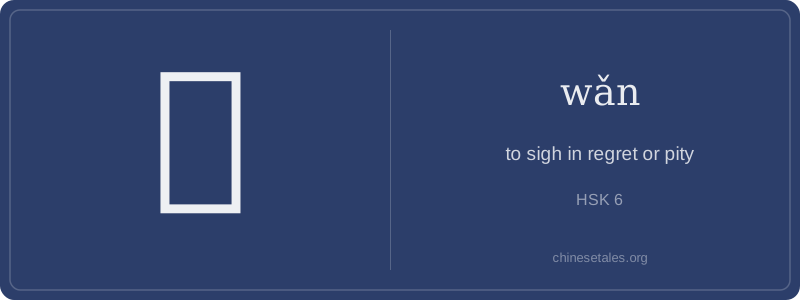
The earliest form of 惋 appears in bronze inscriptions around 800 BCE as a compound: left side was 心 (heart), right side was 宛 (wǎn), originally a pictograph of a bent, coiled snake — symbolizing something twisted, constrained, or tenderly curved. Over centuries, 心 evolved into the modern 忄 (the ‘heart-mind’ radical), while 宛 simplified from a complex snake-and-bowl shape to today’s elegant, flowing strokes (宀 + 央). The 11-stroke structure solidified by the Han dynasty: three dots on top (representing heart’s pulsing energy), then the graceful, descending curve of 宛 beneath — visually echoing the physical act of sighing: breath drawn inward, shoulders gently slumping.
This visual metaphor deepened in meaning: the ‘coiled’ quality of 宛 came to suggest emotional tension — not anger, but the tight, aching suspension of compassion before release. By the Tang dynasty, poets like Du Fu used 惋 to express sorrow for displaced peasants (‘悯农而惋其苦’), linking moral awareness to visceral response. In the Shuō Wén Jiě Zì (121 CE), Xu Shen defined it as ‘sadness mixed with sympathy’ — cementing its dual nature: personal feeling rooted in ethical witnessing. Its rarity in spoken language today makes it a linguistic heirloom — preserved precisely because it names an emotion too refined for slang.
At its heart, 惋 (wǎn) is the sound of a quiet, inward sigh — not loud grief, but the soft, breathy ache of regret or pity for someone else’s misfortune. It’s deeply emotional yet restrained: think of watching a friend pass up a dream job out of fear, and feeling that gentle, sorrowful ‘ah’ in your chest. Unlike more dramatic words like 哀 (āi, 'grief') or 悲 (bēi, 'sorrow'), 惋 carries nuance — it’s empathetic, reflective, and often literary. You won’t hear it in casual WeChat chats; it lives in essays, historical novels, and speeches about social justice.
Grammatically, 惋 is almost always used as a verb in the pattern ‘惋 + object’ or ‘惋 + 之/其 + noun’, rarely standalone. It pairs naturally with words like 惋惜 (wǎnxī, 'to regret') and often appears after verbs like 深感 (shēn gǎn, 'deeply feel') or 不禁 (bù jīn, 'can’t help but'). Learners mistakenly try to use it like 可惜 (kěxī, 'what a pity!') — but 惋 doesn’t work as an interjection. Saying *‘惋!’* sounds like quoting classical poetry mid-conversation. Instead, you’d say 深为惋惜 (shēn wéi wǎnxī, 'deeply regret') or 惋其不幸 (wǎn qí bùxìng, 'regret their misfortune').
Culturally, 惋 reflects Confucian empathy — not just feeling bad, but morally recognizing another’s loss as worthy of solemn attention. It’s common in obituaries, historical retrospectives, and critiques of injustice (e.g., 惋叹社会不公). A classic pitfall? Confusing it with 挽 (wǎn, 'to mourn' — as in funeral rites), which shares the same pinyin but different radical and tone usage. Also, never omit the 忄 — writing it as 免 (miǎn) or 宛 (wǎn) changes everything!