惑
Character Story & Explanation
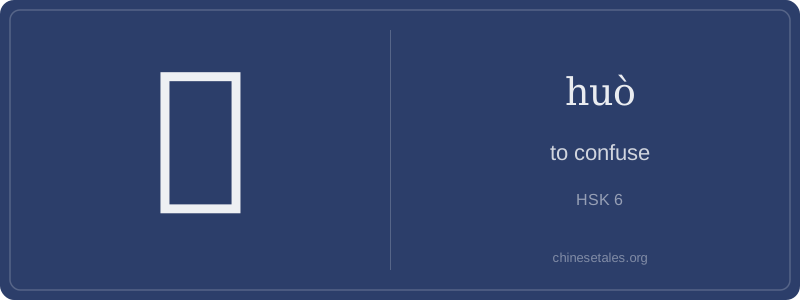
The earliest form of 惑, seen in Warring States bamboo slips, was a vivid composite: the top half resembled 彳 (a walking path) + 或 (a phonetic component meaning 'region' or 'scepter'), while the bottom was 心. But crucially, the upper part wasn’t static — oracle bone precursors show a figure with arms raised in bewilderment beside a pictograph of a weapon or ritual object, suggesting disorientation *in the face of authority or the unknown*. Over centuries, the top simplified into the modern 殿-like shape (actually derived from 或), and the 心 radical dropped slightly, becoming the clear 'heart' base we see today — 12 strokes total, with the final dot anchoring the emotional weight.
This visual evolution mirrors its semantic journey: from ancient divination contexts — where priests might be 惑 by ambiguous cracks in oracle bones — to philosophical texts like the *Zhuangzi*, which uses 惑 to describe the mind’s struggle when confronting Daoist paradoxes ('the fish leaps, yet the net holds nothing — how can this be?'). The character’s enduring power lies in how its structure literally places confusion *inside the heart*: not just a thought, but a felt disturbance, making it one of Chinese’s most psychologically precise characters.
At its heart, 惑 (huò) isn’t just ‘to confuse’ — it’s the visceral feeling of mental vertigo: your thoughts spinning, logic fraying, certainty dissolving. Unlike simpler verbs like 迷 (mí, 'to get lost'), 惑 carries psychological weight — it implies doubt seeded *by something external* (a paradox, a lie, a sudden contradiction) or internal (self-doubt, moral uncertainty). Its radical 心 (xīn, 'heart/mind') tells you this confusion lives in the core of cognition and emotion, not just perception.
Grammatically, 惑 is almost always transitive and formal — you don’t ‘confuse’ in casual speech with this character; you 惑于 ('be confused *by*'), 惑乱 ('confuse and disrupt'), or use it in compound nouns like 困惑 (kùnhuò, 'perplexity'). Crucially, it rarely appears alone as a verb in modern speech: you’d say 我很困惑 (wǒ hěn kùnhuò), not 我惑. Learners often mistakenly use it like English ‘confuse’ — e.g., *他惑我* — but that’s ungrammatical; instead, it’s 他让我困惑 (tā ràng wǒ kùnhuò) or 他使我迷惑 (tā shǐ wǒ míhuò).
Culturally, 惑 appears in classical warnings about moral corruption — Confucius warned against being 惑于色 ('bewitched by beauty') or 惑于利 ('dazzled by profit'). Modern usage retains this gravity: 惑 is found in academic discourse, political rhetoric, and psychological writing — never in texting or memes. A common error is overusing it where simpler words like 不懂 (bù dǒng) or 糊涂 (hútu) would sound more natural and human.