蠢
Character Story & Explanation
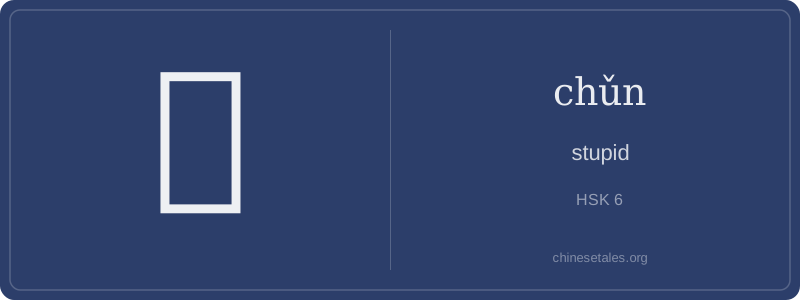
The earliest form of 蠢 appears in Warring States bamboo slips as a complex pictograph: two 'insect' (虫) components flanking a central element resembling 'spring' (春) — but actually an ancient glyph for 'to move slowly' or 'to wriggle'. Over centuries, the left-side 虫 merged with the top part of 春, and the right-side 虫 became stylized into the bottom 虫 we see today — giving us the modern 21-stroke beast: three stacked 虫-like shapes (the top two are remnants of 春’s 日 and elements), all anchored by a final, emphatic 虫 radical at the bottom. Visually, it’s like watching three worms try — and fail — to coordinate a dance.
This visual chaos mirrors its semantic journey: originally in the Shuōwén Jiězì (121 CE), 蠢 meant 'to stir, to rouse' — as insects emerge from dormancy — then shifted to 'restless, uncontrolled movement', and by the Tang dynasty, 'foolish activity born of confusion'. The classical poet Du Fu used it in a line criticizing officials who ‘act without thought, like spring insects stirred without purpose’ — cementing the link between mindless motion and intellectual failure. Its insect radical isn’t decorative: it’s the core metaphor — stupidity as biological, instinctual, and utterly unrefined.
At first glance, 蠢 (chǔn) feels like a blunt, almost rude word for 'stupid' — and yes, it *is* strong. But unlike English 'stupid', which often targets intelligence, 蠢 carries visceral, almost physical connotations: clumsiness, sluggishness, foolish impulsivity — like a worm thrashing uselessly in mud. It’s not neutral; it’s judgmental, sometimes playful among close friends ('Don’t be such a chǔn person!'), but dangerous in formal or sensitive contexts.
Grammatically, it’s an adjective that usually appears before nouns (蠢人 chǔn rén 'foolish person') or after 是 (shì) in predicative position (他很蠢 tā hěn chǔn 'He’s foolish'). Crucially, it *cannot* be reduplicated (✗蠢蠢) and rarely takes degree adverbs like 非常 — instead, you’ll see 极其蠢 (jíqí chǔn) or 真蠢 (zhēn chǔn). Learners often mistakenly use it like 'dumb' in English slang ('That’s so chǔn!'), but native speakers rarely say 蠢 alone as an interjection — it needs a noun or context to land.
Culturally, calling someone 蠢 implies moral laziness, not low IQ — it’s about *choosing* ignorance or ignoring obvious consequences. In classical texts, it’s tied to Confucian ideals of thoughtful action; Mencius even links 蠢 behavior to failing basic human empathy. And beware: while 蠢 is HSK 6, its emotional weight makes it far more advanced than its level suggests — many learners overuse it thinking it’s just 'silly', only to accidentally insult their boss.