惹
Character Story & Explanation
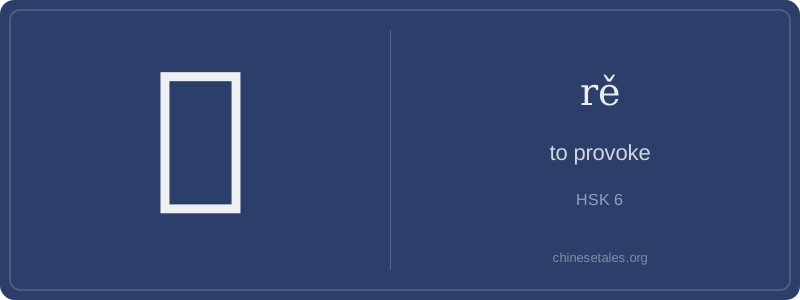
The earliest form of 惹 appears in Han dynasty clerical script, not oracle bones — it’s a relatively late-comer among common characters. Its structure reveals its origin: the left side is 若 (ruò), originally a pictograph of a woman with flowing hair and hands raised in ritual gesture (later simplified to resemble ‘grass’ + ‘mouth’ + ‘hand’), while the right side is 心 (xīn), ‘heart/mind’. In early usage, 若 carried connotations of ‘compliance’ or ‘resemblance’, but here it phonetically anchors the sound rě — a clever borrowing, since 若 itself is pronounced ruò. Over centuries, the top of 若 simplified from 艹+右 to 艹+若’s modern top, and the 心 radical subtly shifted from bottom to right, cementing its emotional domain.
By the Tang dynasty, 惹 had crystallized into its current meaning: ‘to stir up emotionally’ — appearing in poetry like Bai Juyi’s lines lamenting how spring scenery 惹愁 (rě chóu, ‘provokes sorrow’). Its semantic evolution mirrors a cultural insight: emotions aren’t just felt — they’re *invited* or *triggered* by external acts. The 心 radical doesn’t mean ‘this is about feelings’ — it means ‘this act lands *in the heart* and sets off reactions’. That’s why 惹 is never passive: it always marks the instigator, however innocent — a linguistic fingerprint of China’s relational ethics.
At its core, 惹 (rě) isn’t just ‘to provoke’ — it’s the quiet spark before the flame: an action that *unintentionally* or *carelessly* stirs up trouble, emotion, or attention. Think less ‘deliberately antagonize’ and more ‘accidentally set off a chain reaction’ — like wearing loud socks to a funeral (惹人注目) or joking about someone’s ex (惹麻烦). The character carries a subtle moral weight in Chinese: it implies responsibility for consequences you didn’t mean to cause.
Grammatically, 惹 is almost always transitive and appears in verb–object constructions — never alone. It rarely takes aspect particles like 了 or 过 directly; instead, it prefers structures like 惹 + noun (惹祸, 惹怒) or 惹 + verb phrase (惹得大家哄堂大笑). Crucially, it *cannot* take a person as direct object without a particle: you say 惹他生气 (rě tā shēngqì), not ❌惹他. Learners often overuse it as a generic ‘to annoy’, but it’s far more specific than 烦 or 气 — it’s about causation, not state.
Culturally, 惹 reflects the Confucian sensitivity to ripple effects: one small act can disturb harmony (和), so 惹 carries faint disapproval — even in neutral contexts like 惹眼 (‘eye-catching’), there’s a whisper of ‘too much attention’. A classic mistake? Using it where English says ‘to attract’ positively — 惹 love sounds like ‘provoke love’ (awkward!), not ‘win affection’. For positive attraction, use 吸引 or 赢得. Also, note: it’s almost never used in formal writing without a complement — standalone 惹? That’s like saying ‘provoked’ and stopping mid-sentence.