愚
Character Story & Explanation
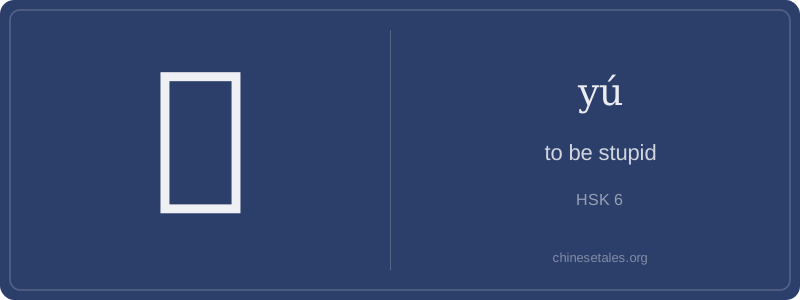
The earliest form of 愚 appears in bronze inscriptions around 1000 BCE — not as a picture of a person, but as a stylized 'hand holding a tool' (禺, the top component) above 'heart' (心). 禺 (yú) itself was originally a pictograph of a monkey-like creature with exaggerated ears — symbolizing attentiveness gone awry: hearing much but understanding little. Over centuries, the 'hand + tool' evolved into the modern 禺 (with 亠, 丨, 丿, 一, 田, 儿), while the 'heart' radical dropped below, anchoring the meaning emotionally — foolishness as a failure of the heart-mind, not just the brain.
This visual logic deepened in classical texts: Confucius uses 愚 in the Analects (17.3) to describe those who 'love virtue but lack wisdom' — not morally bad, but dangerously naive. The character’s structure mirrors this: the top 禺 suggests surface-level perception (ears, eyes), while the bottom 心 reveals the deeper failing — misaligned intention. Even today, calling someone 愚 isn’t about IQ; it’s accusing them of ignoring truth their heart already knows — making 愚 one of Chinese’s most psychologically rich 'negative' words.
At first glance, 愚 (yú) feels harsh — 'stupid', 'foolish' — but in Chinese, it’s rarely used as a blunt insult like 'idiot' in English. Instead, it carries a quiet, almost literary weight: think self-deprecation ('my humble opinion'), moral failure ('foolish pride'), or philosophical blindness ('ignorance of the Dao'). It’s deeply tied to *xin* (heart-mind), not just intellect — which is why its radical is 心, not 口 or 言. This tells you: in Chinese thought, foolishness isn’t just wrong thinking — it’s a heart out of alignment with virtue.
Grammatically, 愚 is almost never used alone as a verb ('to be stupid'). You’ll see it mainly in compounds (e.g., 愚蠢, 愚昧) or as an adjective before nouns (愚见 yú jiàn — 'my foolish opinion', a polite way to preface disagreement). A classic mistake? Using 愚 directly like 'He is 愚' — that sounds archaic or poetic, not natural. Instead, say 他很愚蠢 (tā hěn yúchǔn) or use it reflexively: 自以为是,实则愚不可及 (zì yǐ wéi shì, shí zé yú bù kě jí — 'thinks he’s right, but is utterly foolish').
Culturally, 愚 appears in paradoxical praise — like 愚公移山 (Yúgōng Yí Shān, 'The Foolish Old Man Who Moved Mountains'), where 'foolishness' becomes stubborn virtue. Learners often miss this nuance and translate 愚 too literally, missing the humility, irony, or moral gravity it conveys. Also: it’s tone 2 (yú), not yǔ — mispronouncing it as 'yǔ' (like 雨) accidentally turns your 'foolish opinion' into 'rain opinion'!