愣
Character Story & Explanation
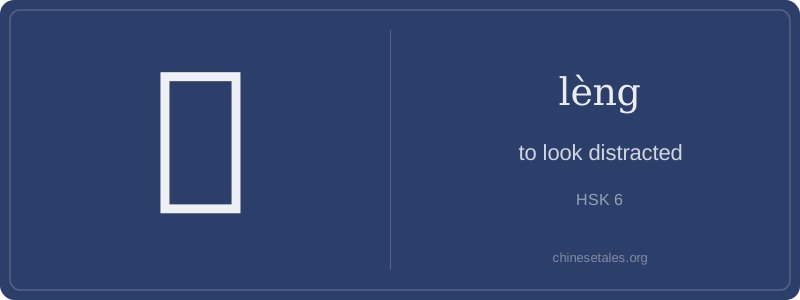
The earliest form of 愣 appears in late Warring States bamboo slips — not as a pictograph, but as a phonosemantic compound already. Its left side 忄 (the 'heart-mind' radical) signals emotional/mental state, while its right side 棱 (léng, 'sharp edge', 'angular ridge') was borrowed for sound and subtly reinforced meaning: like a mind suddenly catching on a jagged, unexpected thought — freezing mid-motion, just as light catches and stops at a sharp棱. Over centuries, the complex 棱 simplified to 棱 → 棱 → 愣, shedding strokes but keeping the angular visual tension in the final two diagonal strokes (丿 and 丶) that mimic a head cocked sideways in bewilderment.
This 'mental snag' meaning solidified by the Ming dynasty, appearing in vernacular novels like Water Margin, where heroes often 'lèng yí xià' ('stumble mentally') before reacting to betrayal or absurdity — signaling moral shock, not ignorance. The character never meant 'stupid' (a common learner misreading); classical usage emphasizes *sudden perceptual interruption*, like a mirror cracking — the image remains, but the mind can’t process it yet.
Imagine walking into a quiet teahouse in Suzhou and seeing an elderly man frozen mid-pour — teapot tilted, steam curling upward, his eyes wide and unfocused, staring blankly at the bamboo screen across the room. That’s 愣: not anger, not sadness, but that sudden, wordless suspension of thought — like your brain hit a soft brick wall. It’s the look you wear when your Wi-Fi drops during a Zoom presentation, or when someone asks, 'What’s the square root of 27?' and your mind just… blanks.
Grammatically, 愣 is almost always used as a verb or adjective in short, vivid snapshots — never alone, but paired with particles like 住 (lèng zhù, 'to freeze up'), 了 (lèng le, 'just zoned out'), or as part of compound verbs like 愣神 (lèng shén, 'to space out'). You’ll rarely see it in formal writing; it’s a spoken, visceral, slightly colloquial word — think 'gaped', 'zoned out', or 'stood there like a statue'. It’s never used for prolonged distraction (that’s 发呆), only that sharp, startled pause.
Culturally, 愣 carries gentle humor, not judgment — it’s how Chinese speakers affectionately tease a friend who missed an obvious cue. Learners often overuse it trying to translate 'confused' or 'surprised', but 愣 isn’t about cognition (that’s 迷惑) or emotion (that’s 吃惊). It’s purely about *visible mental stillness*. Mistake it for 怠 (dài, 'negligent') or 懈 (xiè, 'slack') and you’ll accidentally accuse someone of laziness instead of momentary awe.