惨
Character Story & Explanation
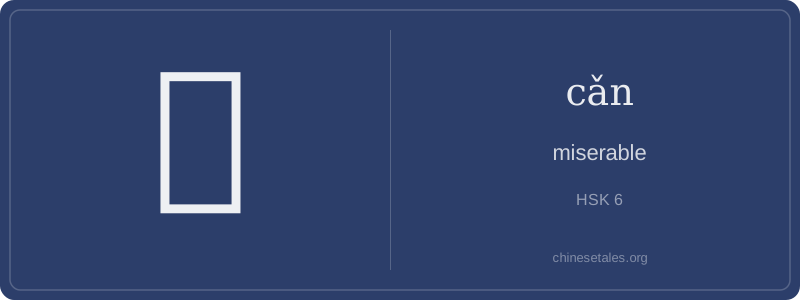
The earliest form of 惨 appears in Warring States bamboo texts as a variant of 慘, combining 忄 (heart/mind radical) with 參 (cān, originally a star cluster pictograph, later phonetic). Its bronze script ancestor showed 心 + 參 — not stars, but three vertical strokes suggesting repeated, piercing blows to the heart. Over centuries, 參 simplified: the top three dots became 曹 (cáo), then further condensed into the modern 参 shape, while the left 忄 (a cursive evolution of 心) anchored the emotional core. By the Han dynasty, the 11-stroke structure stabilized: two dots above, then three horizontal strokes, a hook, and the right-side '参' skeleton — each stroke echoing a stab of anguish.
This visual violence shaped its meaning: classical texts like the Shuōwén Jiězì defined it as 'painful to the heart, deeply distressed'. In Tang poetry, Du Fu used 惨 to describe war-torn landscapes where 'the wind howls with sorrow' — not gentle sadness, but the landscape itself bleeding grief. The character’s 'three-pronged' right side (reminiscent of a trident or broken spear) never lost its association with inflicted suffering: whether a scholar’s failed exam (‘落第惨然’) or a dynasty’s collapse (‘国破家亡,惨不忍睹’), 惨 always implies trauma that pierces the soul and leaves visible scars.
Think of 惨 (cǎn) as Chinese’s ‘grim reaper’ adjective — not literally supernatural, but it carries the same chilling finality you’d feel hearing a minor-key chord in a Hitchcock score. It doesn’t just mean 'miserable'; it conveys visceral, often public, suffering — shattered hopes, crushing defeat, or grotesque misfortune. Unlike English 'sad' (soft, private), 惨 hits hard and loud: a stock market crash isn’t 'sad', it’s 惨; a botched wedding isn’t 'awkward', it’s 惨.
Grammatically, 惨 is unusually flexible: it can be a standalone predicate ('太惨了!'), an adverbial modifier ('惨败'), or even intensify verbs ('惨叫'). Crucially, it rarely describes internal emotions alone — you wouldn’t say '我今天很惨' to mean 'I’m feeling down'; that sounds like you’ve been hit by a bus. Instead, use it for objective, observable wretchedness: '他考试考了15分,太惨了!' (He scored 15/100 — how utterly grim!). Learners often overuse it like English 'terrible', missing its cultural weight: 惨 implies helplessness, inevitability, and social exposure — think 'cringe-worthy disaster', not 'bad day'.
Culturally, 惨 thrives in hyperbole and dark humor — Chinese netizens say '这操作太惨了' ('This move is tragically awful') about a clumsy TikTok fail, turning despair into shared laughter. But in formal writing or news, it signals genuine catastrophe: 惨案 (cǎn àn, 'atrocious incident') is reserved for massacres or industrial disasters. Mistake this for a synonym of 哀 (āi, 'grief') or 悲 (bēi, 'sorrow'), and you’ll sound either melodramatic or dangerously detached from reality.