欲
Character Story & Explanation
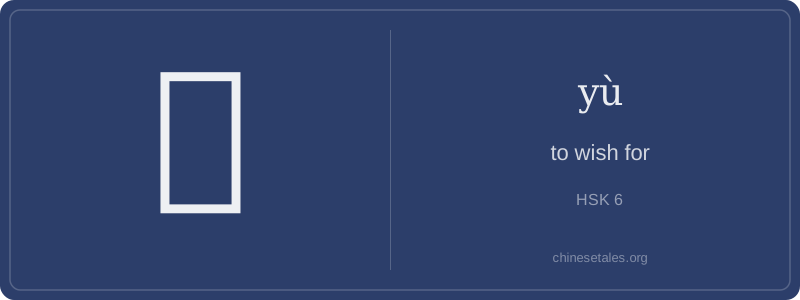
Trace back to oracle bone script (c. 1200 BCE), and 欲 began as a vivid scene: a kneeling person (the top component, later stylized as + 月) facing a bowl of food (represented by the bottom part, which evolved into 欠 — originally depicting an open mouth gasping or sighing). The earliest forms literally showed someone crouched before sustenance, mouth agape — pure, embodied craving. Over centuries, the kneeling figure merged with the ‘flesh’ radical (月, here a variant of 肉 ròu), while the mouth radical 欠 remained unmistakably present — reminding us that desire starts with breath, voice, and bodily need.
This visual logic held firm through bronze inscriptions and seal script: desire was never abstract — it was physiological, vocal, urgent. By the Han dynasty, 欲 appeared in the *Shuōwén Jiězì* dictionary as ‘wanting to obtain’, explicitly tied to the ‘mouth-open’ radical 欠. Classical poets like Du Fu used it to express poignant yearning (‘欲渡黄河冰塞川’ — ‘Wishing to cross the Yellow River, but ice blocks the way’), where 欲 conveys both intention and thwarted momentum. Even today, the character’s shape whispers its origin: eleven strokes forming a body leaning forward, mouth open — not thinking, but *reaching*.
At its heart, 欲 (yù) isn’t just ‘to wish for’ — it’s the quiet hum of human longing: a visceral, often unspoken pull toward something desirable, whether physical (food, rest), emotional (affection, recognition), or philosophical (enlightenment, freedom). Unlike the neutral 想 (xiǎng, ‘to think/want’), 欲 carries weight — it implies intensity, sometimes urgency, and occasionally moral ambiguity. In classical texts, it’s frequently paired with restraint (e.g., 克己复礼, ‘overcome self-desire to restore ritual’), revealing how deeply Chinese thought links desire with self-cultivation.
Grammatically, 欲 shines in formal and literary registers. It functions as a verb meaning ‘to wish to’ or ‘to be about to’ — but crucially, it *must* be followed by another verb (e.g., 欲言, ‘wishes to speak’; 欲雨, ‘is about to rain’). Learners often mistakenly use it like English ‘want’ + noun (❌欲水), when only verbs or abstract nouns work (✅欲饮, ✅欲望). It also appears as the noun form 欲望 (yùwàng, ‘desire’) — now standard in modern Mandarin, though historically more charged.
Culturally, 欲 walks a fine line: Confucianism sees unchecked desire as disruptive, while Daoist and Buddhist traditions treat it as natural energy to observe, not suppress. A common error? Overusing 欲 in spoken Chinese — native speakers prefer 想 or 要 in daily talk. Reserve 欲 for writing, speeches, or poetic effect. Also, watch tone: yù (4th) is distinct from yú (2nd, ‘fish’) or yǔ (3rd, ‘rain’); mispronouncing it can shift your sentence from ‘I wish to leave’ to ‘I fish to leave’ — which, frankly, makes no sense at all.