忧
Character Story & Explanation
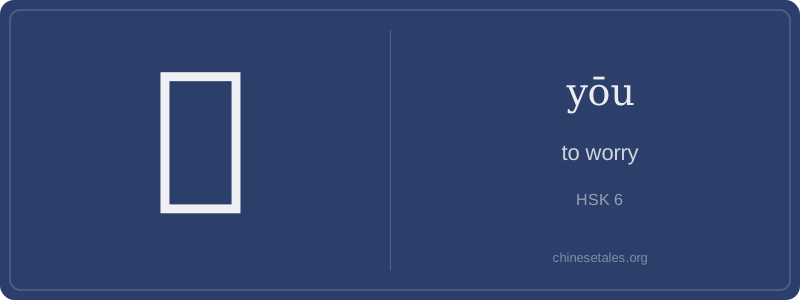
The earliest form of 忧 appears in bronze inscriptions as a pictograph combining 心 (heart) and 尤 — an ancient glyph depicting a hand holding a bent arm, symbolizing ‘excess’ or ‘outstanding trouble’. Over time, the heart radical shifted leftward into the modern 忄 (‘heart-side’), while 尤 simplified into its current shape — three horizontal strokes above a vertical stroke with a hook. Crucially, the top of 尤 was originally a stylized ‘arm raised in distress’, not just decorative lines. By the Han dynasty, the seven-stroke structure we know today was standardized: two dots (忄), then 尤 — no extra flourishes, no hidden radicals.
This visual evolution mirrors its semantic journey: from visceral, bodily distress (the raised arm + heart) to refined emotional gravity. In the Analects, Confucius uses 忧 only in moral contexts — ‘君子不忧不惧’ (‘The noble person is neither anxious nor fearful’), framing 忧 as a failure of virtue, not mere emotion. Later, poets like Du Fu layered it with social conscience: ‘忧端齐终南’ (‘My worries rise as high as Zhongnan Mountain’). Even today, the character’s compact form — just seven strokes — belies its philosophical heft: a tiny vessel holding millennia of ethical introspection.
Imagine a quiet courtyard in Beijing during autumn — leaves swirling, tea cooling in a cup. Your Chinese friend sighs softly and says, 'Wǒ yǒu yì diǎn yōu.' That ‘yōu’ isn’t just ‘worry’ like a sudden panic attack; it’s deeper — a low hum of concern, almost poetic: the weight of responsibility, the ache of uncertainty, the thoughtful frown before making a big decision. In Chinese, 忧 is never shouted; it’s whispered, written in essays, and embedded in classical phrases — always carrying gravity, never triviality.
Grammatically, 忧 is primarily a verb (‘to worry’) or noun (‘a worry’), but unlike English, it rarely stands alone in speech. You’ll almost always see it in compounds (e.g., 担忧, 忧虑) or with modifiers: 不必忧 (‘no need to worry’), 忧心忡忡 (‘deeply anxious’). Learners often mistakenly use it like ‘worry’ in ‘I worry about you’ — but direct object constructions like *‘wǒ yōu nǐ’ are ungrammatical. Instead, say ‘wǒ wèi nǐ dānyōu’ (I worry *for* you). The preposition matters — 忧 needs a bridge.
Culturally, 忧 carries Confucian resonance: it’s the noble, self-aware concern of a scholar-official for state and family — not neurotic fretting. That’s why it appears in idioms like ‘先天下之忧而忧’ (‘Worry before the world worries’) from Fan Zhongyan’s famous essay. Mistake it for casual anxiety, and you miss its moral weight. Also beware: 忧 is *not* used in positive contexts — you’d never say ‘happy and worried’ — because in Chinese logic, true 忧 excludes lightness. It’s solemn, deliberate, and deeply human.