惫
Character Story & Explanation
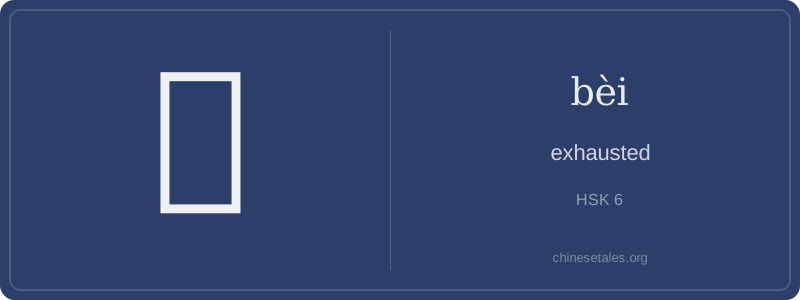
The earliest form of 惫 appears in Warring States bamboo slips — not as a pictograph, but as a phonosemantic compound already fully formed. Its left side, 忄 (the ‘heart-mind’ radical), signals emotional/physiological interiority; its right side, 夊 (suī), is the key: an ancient character depicting a foot dragging slowly, heel-first, across ground — think of a soldier staggering home after battle, each step heavy and deliberate. Over centuries, the foot radical simplified from a full leg-and-foot glyph into the three-stroke 夂 we see today, while the heart radical condensed from ⺗ to 忄. Stroke order reinforces this: start with the ‘heart’ (dots and vertical), then build the weary ‘foot’ — literally writing exhaustion from the inside out.
This visual metaphor — heart + dragging foot — anchored its meaning from the start. In the Zuo Zhuan, 惫 describes ministers ‘exhausted by ritual obligations’; in Du Fu’s Tang poetry, it evokes refugees ‘weary unto death’ (疲惫而死). Notably, 惫 never meant physical fatigue alone — it always implied the mind-heart’s surrender to sustained pressure. That’s why modern usage retains its solemn weight: it’s not how you feel after Netflix, but how you feel after rewriting your thesis for the fifth time while caring for sick parents — the kind of exhaustion that leaves silence in its wake.
Think of 惫 (bèi) as Chinese’s version of the 'soul-crushed' emoji — but with ancient gravitas. It doesn’t just mean ‘tired’; it conveys deep, bone-deep exhaustion that blurs into mental fog or moral weariness — like finishing a 72-hour ICU shift *and* resolving your family’s generational feud in the same week. Unlike generic 累 (lèi), which you’d use after climbing stairs, 惫 appears only in formal, literary, or high-stakes contexts: medical reports, classical poetry, or corporate memos describing burnout at the executive level.
Grammatically, 惫 is almost always an adjective — but crucially, it *never stands alone*. You’ll never say ‘我惫’; instead, it appears in compounds (心力交瘁, 疲惫不堪) or as a predicate with modifiers: 他疲惫得说不出话 (Tā píbèi de shuō bu chū huà — He was so exhausted he couldn’t speak). Learners often misplace it like an English adjective — but in Chinese, it craves scaffolding: degree adverbs (极, 深, 极度), reduplication (疲惫疲惫), or structural particles (得, 而).
Culturally, 惫 carries quiet dignity — no melodrama, no sighing. It’s the exhaustion of duty fulfilled, not laziness lamented. A common mistake? Using it in casual speech (e.g., texting ‘今天好惫’). Native speakers would blink — then gently correct you to 累 or 困. Also, beware tone: bèi sounds like ‘bait’, not ‘bay’ — mispronouncing it as bēi risks confusion with 杯 (cup) or 悲 (sorrow), both emotionally adjacent but semantically worlds apart.