惮
Character Story & Explanation
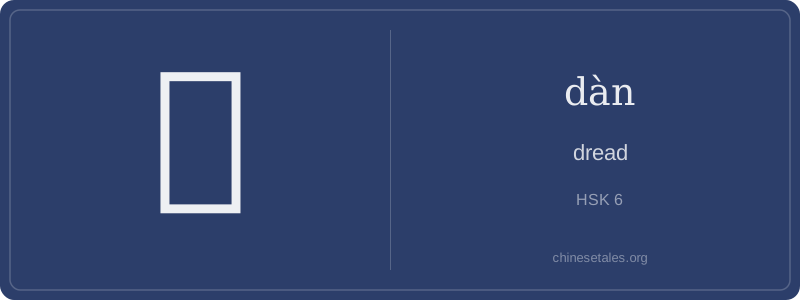
The earliest form of 惮 appears in bronze inscriptions as 心 + 單 (a simplified variant of 單, meaning ‘single’ or ‘unadorned’). The left side was 心 (heart/mind), later stylized into 忄 (the ‘heart radical’), while the right side evolved from 單 — originally a pictograph of a hunting net stretched over a pole, symbolizing singularity or exposure. Over centuries, the net shape condensed into the modern 单 (dān), but in 惮, it retained its older, more angular form — notice how the top stroke of 单 looks like a taut line under tension, mirroring the psychological ‘tension’ of dread.
This visual tension became semantic: the exposed, unshielded heart — vulnerable yet aware — gave rise to the meaning ‘to dread’, especially dread born of moral clarity. By the Warring States period, 惮 appears in the *Zuo Zhuan* describing ministers who ‘do not dread death’ (不惮死) when upholding righteousness — not fearless, but undeterred by fear’s weight. Its endurance in formal writing reflects how deeply Chinese culture ties emotional restraint to ethical courage: dread acknowledged, then transcended.
At its heart, 惮 (dàn) isn’t just ‘fear’ — it’s the quiet, heavy dread that makes your shoulders tense before a difficult conversation or a high-stakes presentation. It’s not panic (慌) or terror (恐), but a deep, reflective apprehension rooted in respect, responsibility, or moral weight. Think of it as ‘dread with dignity’: you’re not running; you’re pausing, weighing consequences, feeling the gravity of what’s at stake.
Grammatically, 惚 is almost always used in formal or literary contexts — rarely in casual speech. It appears primarily in two patterns: after verbs like 不 (bù) or 未 (wèi) to form negative constructions (e.g., 不惮, 未惮), or in classical-style compound nouns like 惮惧 (dànjù). You’ll almost never see it alone as a verb — it’s not ‘I dread’ but ‘I do not dread’ (不惮) or ‘without dread’ (无惮). Learners often mistakenly try to use it like 畏 (wèi) or 怕 (pà), but 惮 resists colloquialization — it’s the character Chinese writers choose when they want gravitas, not goosebumps.
Culturally, 惮 carries Confucian resonance: it implies awareness of duty and consequence. In classical texts, sages are praised for 不惮劳苦 (bù dàn láo kǔ) — ‘not shrinking from hardship’ — where the dread isn’t of pain, but of failing one’s role. A common mistake? Confusing it with 但 (dàn, ‘but’) — same pinyin, totally unrelated meaning and origin. Remember: 忄 + 单 = emotional weight, not logical contrast.