愤
Character Story & Explanation
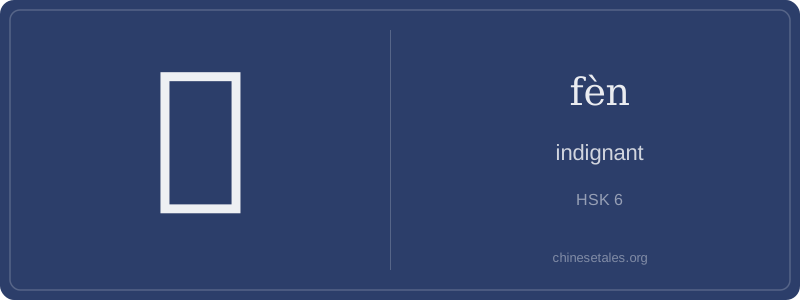
The earliest form of 愤 appears in bronze inscriptions around 1000 BCE — not as a pictograph, but as a phonosemantic compound already. Its left side 忄 (the ‘heart-mind’ radical) signals emotional content, while the right side 奋 (fèn, originally depicting a bird flapping wings upward with vigor) provided both sound and semantic resonance: rising energy, stirring force. Over centuries, 奋 simplified from 鳮 (a complex bird + field glyph) to 奋, and 愤 stabilized into its current 12-stroke form by the Han dynasty — every stroke now purposeful: three dots for the heart’s pulse, then the dynamic thrust of 奋’s raised arms and energetic legs.
This visual synergy — heart + vigorous uprising — perfectly captures how 愤 evolved: from early texts like the *Zuo Zhuan*, where it described rulers’ justified wrath against treachery, to Tang poetry expressing sorrowful indignation over lost dynasties, to modern essays on social justice. The character doesn’t just name emotion — it enacts it: the 忄 anchors it in conscience, while 奋 insists it must *move*, must *rise up*. As Sima Qian wrote in *Records of the Grand Historian*, ‘The sages composed works in愤’ — channeling righteous fury into enduring creation.
At its heart, 愤 isn’t just ‘anger’ — it’s the seething, morally charged indignation that rises when fairness is violated: a teacher grading unfairly, a corrupt official escaping consequences, or someone cutting in line at a crowded hospital. It carries weight, judgment, and often a quiet, burning intensity — not explosive rage (that’s 怒), but the kind of anger that fuels petitions, editorials, or late-night WeChat rants among intellectuals. It’s deeply relational: you’re 愤 because *someone else* broke an unspoken social contract.
Grammatically, 愤 is almost never used alone as a verb in modern Mandarin — you won’t say ‘I fèn’ like ‘I run’. Instead, it appears in set phrases (愤慨, 愤怒) or as a noun meaning ‘indignation’ (e.g., 愤不平 — ‘righteous indignation’). It frequently modifies nouns (愤懑的情绪) or appears after verbs like 表达, 发泄, or 抑制. Learners often mistakenly try to use it as a standalone verb (❌ 我愤他) — but native speakers say 我对他感到愤慨 or 我愤愤不平.
Culturally, 愤 reflects the Confucian ideal of righteous anger — anger rooted in ren (benevolence) and yi (righteousness), not selfishness. Mencius praised ‘the indignation of the noble person’ (君子之愤) as a moral compass. Ironically, modern usage often carries subtle caution: too much 愤 can imply impractical idealism or emotional volatility — hence phrases like 愤青 (‘angry youth’) sometimes carry a mildly ironic or skeptical tone, especially in official discourse.