宪
Character Story & Explanation
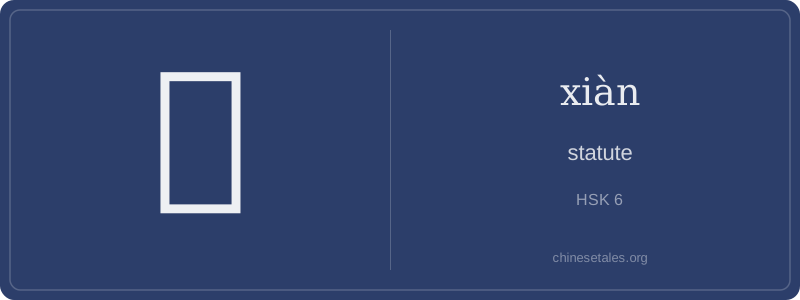
The earliest form of 宪 appears on Warring States bamboo slips — not as a pictograph of law books (which didn’t exist yet), but as a compound of 宀 (mián, 'roof') and ‘先’ (xiān, 'first') — originally written with a hand holding a ceremonial staff under shelter. The roof symbolized protection and order; the 'first' element emphasized primacy and precedence. Over time, the hand-and-staff simplified into the modern 先 component (with its characteristic 三横一竖 + 斤), while 宀 retained its sheltering shape — nine strokes total, each reinforcing the idea of a foundational, topmost standard established under communal protection.
This visual logic shaped its meaning evolution: from 'that which comes first and sets the standard' (Zhou dynasty ritual texts) to 'model ordinance' (Han dynasty administrative documents) to today’s 'constitution'. In the *Analects* (16.2), Confucius says '君子之德风,小人之德草,草上之风必偃' — and commentators note that true virtue must align with the ruler’s 宪, i.e., his exemplary ordinances. Even then, 宪 wasn’t about punishment — it was about resonance: laws that matched cosmic and moral order, so people followed them naturally, like grass bending before wind.
At its core, 宪 (xiàn) feels like a quiet pillar — not flashy, but foundational. It doesn’t shout; it *stands*. In modern Chinese, it almost exclusively means 'statute', 'constitution', or 'constitutional law' — always formal, always authoritative, and almost always paired with other characters (never used alone). Think of it as the linguistic equivalent of marble columns in a courthouse: elegant, unyielding, and deeply institutional. You’ll rarely hear someone say '这是一条宪' — no, it’s always 宪法 (xiàn fǎ, 'constitution'), 宪政 (xiàn zhèng, 'constitutional government'), or 宪令 (xiàn lìng, 'statutory decree'). Its tone is solemn, its register high — it belongs in legal texts, political speeches, and history exams, not casual WeChat chats.
Grammatically, 宪 is strictly a noun or attributive modifier — never a verb or adjective. Learners sometimes mistakenly treat it like a standalone noun ('the constitution' → '宪'), but native speakers always use 宪法. Another trap: confusing 宪 with verbs meaning 'to obey' or 'to comply' — 宪 itself carries no action; it’s purely nominal and normative. Its presence signals that what follows is codified, supreme, and binding — like the word 'statute' in English legal phrasing, where 'statute law' ≠ 'law statute'.
Culturally, 宪 carries Confucian weight: in classical texts like the *Book of Rites*, 宪 meant 'model', 'standard', or 'exemplary rule' — something to be emulated, not just enforced. That sense of moral authority still lingers: when China refers to the Constitution as 宪法, it’s not just law — it’s the nation’s highest ethical and political compass. Learners who miss this nuance reduce 宪 to dry legalese; those who grasp it understand why a single character can evoke both parchment and principle.