蒙
Character Story & Explanation
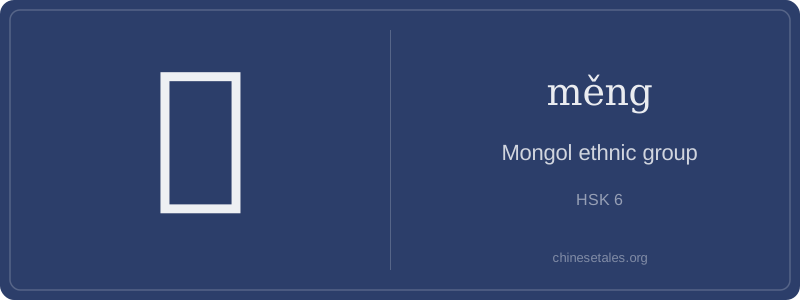
The earliest form of 蒙 appears in Warring States bamboo slips—not as a pictograph of grass, but as a composite ideograph: 上 (up) + 冓 (gōu, an ancient character depicting interlocking beams) + 艹 (grass radical), suggesting ‘something dense and covering from above, like thick vegetation.’ Over centuries, the upper component simplified into 一 and 丶, while the lower part evolved from 冓 to 䜌 (luán, meaning ‘intertwined’) — eventually standardizing into today’s 蒙 with its 13 strokes: three horizontal lines (艹), then a compact 7-stroke lower half that visually mimics tangled threads or layered fabric.
This ‘covering densely’ origin directly birthed its early meanings: ‘to obscure,’ ‘to conceal,’ and ‘to delude’—all captured in classical texts like the Zuo Zhuan, where 蒙 is used for ‘blinding ignorance’ (蒙昧 méngmèi). Yet by the Yuan Dynasty, when Mongol rulers governed China, the character was phonetically borrowed (not semantically) to write ‘Mongol’—a shift so profound it overrode millennia of meaning. Today, the grass radical hints at nothing Mongolian; instead, it’s a silent fossil of the character’s ancient, vegetal roots—still green, even when naming a steppe people.
Think of 蒙 (měng) as China’s linguistic equivalent of a 'nationality tag'—like how 'Welsh' or 'Sami' instantly evokes a distinct ethnic identity, history, and cultural sovereignty. But unlike English demonyms, 蒙 isn’t just an adjective; it’s a proper noun root that anchors the entire Mongol ethnic group (蒙古族 Měnggǔzú) in official, legal, and academic contexts—it appears on ID cards, census forms, and constitutional texts. You’ll never say *‘a měng person’* alone; it only works in compounds like 蒙古 or 蒙族.
Grammatically, this reading is strictly bound to ethnicity—and crucially, it’s *never* used as a verb or adjective. That’s where learners trip: confusing měng with méng (to cover, to deceive) or mēng (to be ignorant). Saying ‘wǒ hěn mēng’ (I’m clueless) is fine—but ‘wǒ shì mēng zú’ is a jarring error that sounds like ‘I am an ignorant tribe.’ The tone and context lock the meaning: měng only lives in proper nouns tied to Mongol heritage.
Culturally, using 蒙 for the Mongol people reflects China’s official ethnic classification system—where 56 groups are each assigned a standardized two-character name (e.g., 满族 Mǎnzú, 回族 Huízú). Mispronouncing it as méng/mēng doesn’t just break grammar; it subtly erases identity. Even native speakers double-check tones here—because getting this wrong isn’t just a slip, it’s a sociolinguistic faux pas.