惩
Character Story & Explanation
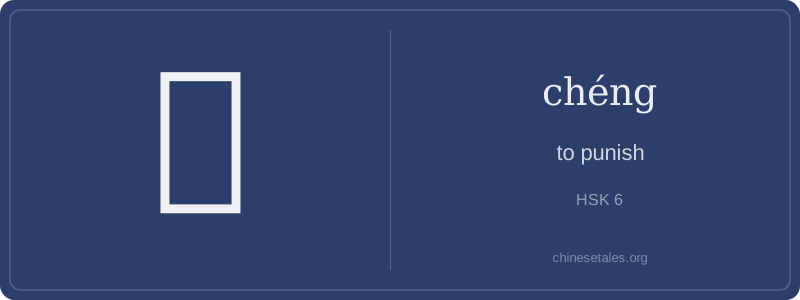
The earliest form of 惩 appears in bronze inscriptions (c. 1000 BCE) as a composite: the left side showed a hand holding a stick ( + 丿, later evolving into 征’s top), and the right side was 心 (heart/mind). But crucially — it wasn’t just ‘hitting’. The original pictograph combined 征 (a phonetic component meaning ‘to go on campaign’ or ‘to subdue’) with 心, suggesting ‘subduing the heart/mind through decisive action’. Over centuries, the 征 part simplified: its ‘foot’ (止) and ‘weapon’ elements condensed into the modern 征-like top (the three horizontal strokes plus slanted stroke), while the 心 radical settled firmly at the bottom — visually anchoring punishment not in the body or law, but in the inner realm of intention and conscience.
This visual logic shaped its semantic evolution. In the *Zuo Zhuan* (c. 4th c. BCE), 惩 appears in phrases like ‘惩恶劝善’ (chěng è quàn shàn) — ‘punish evil to encourage goodness’ — revealing its dual ethical function: not vengeance, but moral calibration. By the Han dynasty, it became standard in legal texts, always paired with verbs implying deliberation (如、以、而). Even today, its 心 radical whispers a quiet truth: true punishment, in Chinese thought, must engage the mind’s capacity for remorse — otherwise, it’s merely force, not 惩.
At its core, 惩 (chéng) isn’t just ‘to punish’ — it’s about *moral correction with intention*. Unlike English ‘punish’, which can feel mechanical or retributive, 惩 carries an implied purpose: to reform, deter, or restore balance. You’ll rarely see it used for light scolding — it’s reserved for serious consequences, often institutional or judicial (e.g., legal penalties, disciplinary actions), and almost always implies that the punishment is *justified* and *deserved*. Think of it as ‘consequence with conscience’.
Grammatically, 惩 is a transitive verb but rarely stands alone in speech — it loves company. It appears most often in compounds (like 惩罚 or 惩处) or in formal, written syntax: 惩以… (‘punish with…’), 惩之以严 (‘punish strictly’), or in passive constructions like 被依法惩处 (‘was lawfully punished’). Learners often mistakenly use it like English ‘punish’ in casual speech — don’t say *Wǒ yào chéng nǐ!* (I’ll punish you!) — it sounds like a judge sentencing someone on the spot. Instead, use 教训 (jiàoxùn) or 罚 (fá) for everyday contexts.
Culturally, 惩 reflects Confucian and Legalist tensions: Confucius emphasized moral self-cultivation over coercion, yet the state needed tools like 惩 to uphold order — hence its frequent pairing with 法 (law) and 诫 (warning). A common mistake? Confusing it with 成 (chéng, ‘to succeed’) — same tone, similar sound, wildly opposite meaning! Also, note that 惩 is almost never used in positive volitional sentences (‘I want to punish’) without heavy context — it’s inherently weighty, solemn, and often impersonal.