悬
Character Story & Explanation
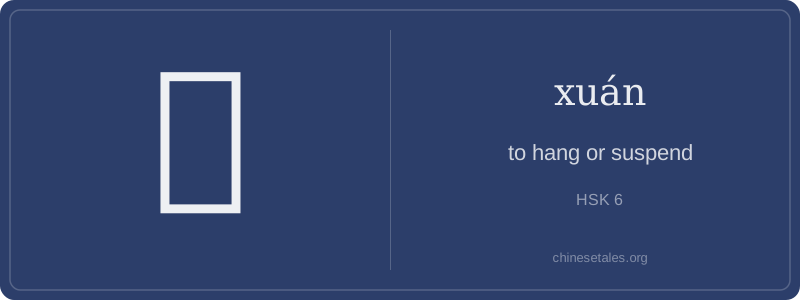
The earliest form of 悬 appears in bronze inscriptions as a complex pictograph: a rope (represented by twisted lines) tied to an object (often a vessel or weight) suspended *above* a heart-like shape (❤️-shaped component, precursor to 心). Over centuries, the upper part simplified into 玄 (xuán, 'profound/dark'), which phonetically anchors the character while subtly reinforcing its sense of mystery—what hangs above us is unknowable. The lower 心 radical wasn’t added for emotion at first; it was a positional marker indicating 'internal state affected by what hangs above'. By the Han dynasty, the structure stabilized into today’s 11-stroke form: 玄 (7 strokes) + 心 (4 strokes), visually balancing cosmic uncertainty above with human response below.
This duality shaped its semantic evolution: from concrete suspension (e.g., 'hanging a bell in a temple') in early texts like the *Zuo Zhuan*, to metaphorical suspense in Tang poetry—Li Bai wrote of stars ‘hanging’ over mountains (星悬高岭), merging astronomy and awe. The 心 radical eventually *did* acquire emotional resonance: by Song dynasty, 悬 was used in 悬思 (xuán sī, 'anxious contemplation'), where the mind itself feels suspended between thought and resolution. Its visual logic remains elegant: what hangs *over* the heart changes the heart.
Think of 悬 (xuán) as Chinese’s version of a tightrope walker—visually precarious, emotionally charged, and grammatically versatile. At its core, it doesn’t just mean 'to hang' like a coat on a hook; it evokes suspension in time, doubt in judgment, or tension in narrative—like the moment before a judge drops the gavel or a cliffhanger freezes your Netflix screen. That’s why it appears in phrases like 悬念 (xuán niàn, 'suspense') and 悬而未决 (xuán ér wèi jué, 'left unresolved'), where physical hanging melts into psychological limbo.
Grammatically, 悬 is almost never used alone as a verb in modern speech—it’s either embedded in compounds or appears in formal/literary constructions. You won’t say 'I suspended the lamp' with 悬 as a bare verb (that’s 挂); instead, you’ll hear it in passive-tinged or abstract contexts: 这个问题悬了 (zhè ge wèn tí xuán le, 'This issue is up in the air'). Note the aspect particle 了—it signals a shift into uncertain status, not completed action. Learners often overuse it like English 'hang', leading to unnatural sentences.
Culturally, 悬 carries a quiet gravity: in classical texts, it described things literally suspended *above* danger—like a sword over one’s head (a direct allusion to the idiom 悬剑空堂, symbolizing unfulfilled duty). Today, that weight persists: 悬案 ('unsolved case') isn’t just 'hanging'—it’s haunting. A common mistake? Confusing it with 挂 (guà), which is everyday 'hang' (clothes, phone calls). 悬 implies stakes, uncertainty, and height—not utility.